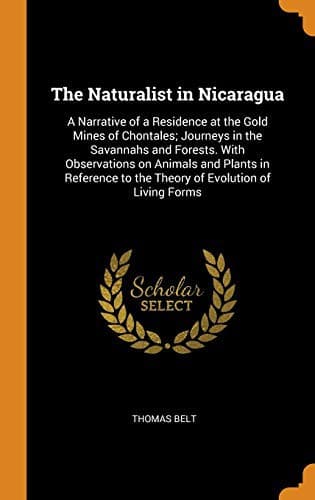
Natural history -- Nicaragua; Nicaragua -- Description and travel
There was one of these outbreaks whilst I was in Nicaragua, and the
whole country was in a state of civil war for more than four
months, nearly all the able-bodied men being drafted into the
armies that were raised, but I believe there were not a score of
men killed on the field of battle during the whole time; the town
of Juigalpa was taken and retaken without any one receiving a
scratch. The usual course pursued was for the two armies to
manoeuvre about until one thought it was weaker than the other,
when it immediately took to flight. Battles were decided without a
shot being fired, excepting after one side had run away.
Of patriotism I never saw a symptom in Central America, nothing but
selfish partisanship, willing at any moment to set the country in a
state of war if there was only a prospect of a little spoil. The
states of Central America are republics in name only; in reality,
they are tyrannical oligarchies. They have excellent constitutions
and laws on paper, but both their statesmen and their judges are
corrupt; with some honourable exceptions, I must admit, but not
enough to stem the current of abuse. Of real liberty there is none.
The party in power is able to control the elections, and to put
their partisans into all the municipal and other offices. Some of
the Presidents have not hesitated to throw their political
opponents into prison at the time of an election, and I heard of
one well-authenticated instance where an elector was placed,
uncovered, in the middle of one of the plazas, with his arms
stretched out to their full extent and each thumb thrust down into
the barrel of an upright musket, and kept a few hours in the
blazing sun until he agreed to vote according to the wish of the
party in power. A change of rulers can only be effected by a
so-called revolution; with all the machinery of a republic, the
will of the people can only be known by the issue of a civil war.
With high-sounding phrases of the equality of man, the lower orders
are kept in a state almost approaching to serfdom. The poor Indians
toil and spin, and cultivate the ground, being almost the only
producers. Yet in the revolutionary outbreaks they are driven about
like cattle, and forced into the armies that are raised. Central
America declared its independence of Spain in 1823, and constituted
itself a republic, under the name of the United States of Central
America. The confederacy, which consisted of Guatemala, San
Salvador, Honduras, Nicaragua, and Costa Rica, was broken up in
1840, when each of the States became an independent republic. Ever
since, revolutionary outbreaks have been periodical, and the
States, with the exception of Costa Rica, have steadily decreased
in wealth and produce.
Public-domain text, read in full here on John Shaqi.
Reviews
Reviews
No reviews yet
Be the first to share your thoughts on this work.
Elsewhere in the archive
Join the Discussion
Join the discussion
Sign in to leave a comment or review.
Sign InorCreate an account