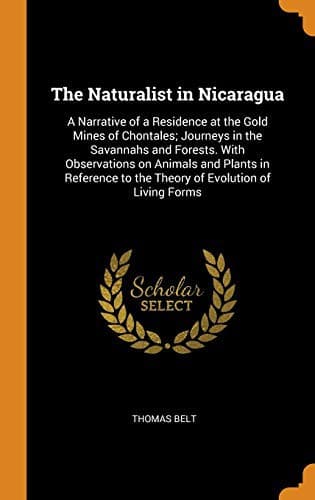
Natural history -- Nicaragua; Nicaragua -- Description and travel
Climate of the north-eastern side of Nicaragua.
Excursions around Santo Domingo.
The Artigua.
Corruption of ancient names.
Butterflies, spiders, and wasps.
Humming-birds, beetles, and ants.
Plants and trees.
Timber.
Monkey attacked by eagle.
White-faced monkey.
Anecdotes of a tame one.
Curassows and other game birds.
Trogons, woodpeckers, mot-mots, and toucans.
THE climate of Santo Domingo and of the whole north-eastern side of
Nicaragua is a very damp one. The rains set in in May, and continue
with occasional intermission until the following January, when the
dry season of a little more than three months begins. Even during
the short-lived summer there are occasional rains, so that although
the roads dry up, vegetation never does, the ground in the woods is
ever moist, and the brooks perennial. In the shady forest,
mosquitoes and sand-flies are rather troublesome; but the large
cleared space about the houses of the mining company is almost free
from them, and in the beautiful light evenings one can sit under
the verandahs undisturbed, watching the play of the moonbeams on
the silky leaves of the bananas, the twinkling north star just
peeping over the range in front, with "Charlie's Wain" in the upper
half of its endless circlings, whilst in the opposite direction the
eye rests on the beautiful constellations of the southern
hemisphere. On the darkest nights innumerable fire-flies flash
their intermittent lights as they pass amongst the low bushes or
herbage, making another twinkling firmament on earth. On other
evenings, sitting inside with lighted candles and wide opened
doors, great bats flap inside, make a round of the apartment, and
pass out again, whilst iris-winged moths, attracted by the light,
flit about the ceiling, or long-horned beetles flop down on the
table. In this way I made my first acquaintance with many
entomological rarities.* (* In moths, numerous fine Sphingidae and
Bombycidae; and in beetles, amongst many others, the rare Xestia
nitida (Bates) and Hexoplon albipenne (Bates) were first described
from these evening captures.)
Public-domain text, read in full here on John Shaqi.
Reviews
Reviews
No reviews yet
Be the first to share your thoughts on this work.
Elsewhere in the archive
Join the Discussion
Join the discussion
Sign in to leave a comment or review.
Sign InorCreate an account