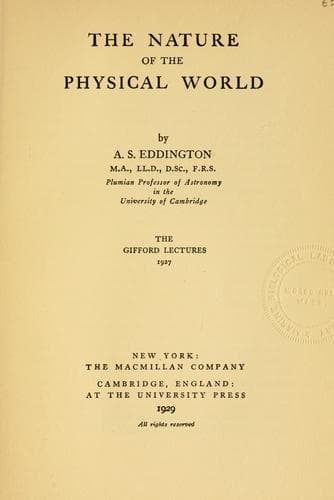
The nature of the physical worldEddington, Arthur Stanley, Sir
Philosophy
The nature of the physical world
Eddington, Arthur Stanley, Sir
Physics -- Philosophy; Science -- Philosophy
I believe that this has a close bearing on the rather heterodox views
of Dr. Whitehead on relativity. He breaks away from Einstein because he
will not admit the non-uniformity of space-time involved in Einstein’s
theory. “I deduce that our experience requires and exhibits a basis
of uniformity, and that in the case of nature this basis exhibits
itself as the uniformity of spatio-temporal relations. This conclusion
entirely cuts away the casual heterogeneity of these relations which
is the essential of Einstein’s later theory.”[22] But we now see that
Einstein’s theory asserts a casual heterogeneity of only one set of
[Pg 146]
ten coefficients and complete uniformity of the other ten. It therefore
does not leave us without the basis of uniformity of which Whitehead in
his own way perceived the necessity. Moreover, this uniformity is not
the result of a law casually imposed on the world; it is inseparable
from the conception of survey of the world from within—which is, I
think, just the condition that Whitehead would demand. If the world of
space-time had been of two or of three dimensions Whitehead would have
been entirely right; but then there could have been no Einstein theory
of gravitation for him to criticise. Space-time being four-dimensional,
we must conclude that Whitehead discovered an important truth about
uniformity but misapplied it.
The conclusion that the extension of an object in any direction in
the four-dimensional world is determined by comparison with the
radius of curvature in that direction has one curious consequence. So
long as the direction in the four-dimensional world is space-like,
no difficulty arises. But when we pass over to time-like directions
(within the cone of absolute past or future) the directed radius is
an imaginary length. Unless the object ignores the warning symbol
it has no standard of reference for settling its
time extension. It has no standard duration. An electron decides
how large it ought to be by measuring itself against the radius of
the world in its space-directions. It cannot decide how long it
ought to exist because there is no real radius of the world in its
time-direction. Therefore it just goes on existing indefinitely.
This is not intended to be a rigorous proof of the immortality of
the electron—subject always to the condition imposed throughout
these arguments that no agency other than metric interferes with the
extension. But it shows that the electron behaves in the simple way
[Pg 147]
which we might at least hope to find.[23]
Public-domain text, read in full here on John Shaqi.
Reviews
Reviews
No reviews yet
Be the first to share your thoughts on this work.
Elsewhere in the archive
Join the Discussion
Join the discussion
Sign in to leave a comment or review.
Sign InorCreate an account