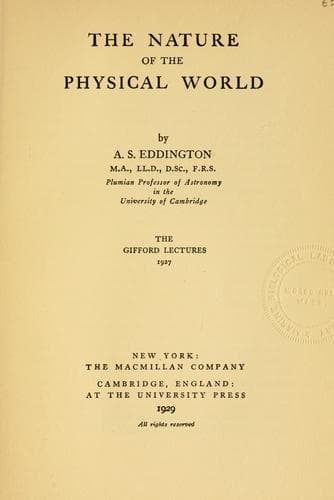
The nature of the physical worldEddington, Arthur Stanley, Sir
Philosophy
The nature of the physical world
Eddington, Arthur Stanley, Sir
Physics -- Philosophy; Science -- Philosophy
I shall have to emphasise elsewhere that the whole of our physical
knowledge is based on measures and that the physical world consists,
so to speak, of measure-groups resting on a shadowy background that
lies outside the scope of physics. Therefore in conceiving a world
which had existence apart from the measurements that we make of it, I
was trespassing outside the limits of what we call physical reality. I
would not dissent from the view that a vagary which by its very nature
could not be measurable has no claim to a physical existence. No one
knows what is meant by such a vagary. I said that the earth might go
anywhere it chose, but did not provide a “where” for it to choose;
since our conception of “where” is based on space measurements which
were at that stage excluded. But I do not think I have been illogical.
I am urging that, do what it will, the earth cannot get out of the
track laid down for it by the law of gravitation. In order to show
this I must suppose that the earth has made the attempt and stolen
nearer to the sun; then I show that our measures conspire quietly to
locate it back in its proper orbit. I have to admit in the end that
the earth never was out of its proper orbit;[25] I do not mind that,
because meanwhile I have proved my point. The fact that a predictable
path through space and time is laid down for the earth is not a genuine
restriction on its conduct, but is imposed by the formal scheme in
which we draw up our account of its conduct.
[Pg 153]
Non-Empty Space. The law that the directed radius is constant
does not apply to space which is not completely empty. There is no
longer any reason to expect it to hold. The statement that the region
is not empty means that it has other characteristics besides metric,
and the metre rod can then find other lengths besides curvatures
to measure itself against. Referring to the earlier (sufficiently
approximate) expression of the law, the ten principal coefficients of
curvature are zero in empty space but have non-zero values in non-empty
space. It is therefore natural to use these coefficients as a
measure of the fullness of space.
Public-domain text, read in full here on John Shaqi.
Reviews
Reviews
No reviews yet
Be the first to share your thoughts on this work.
Elsewhere in the archive
Join the Discussion
Join the discussion
Sign in to leave a comment or review.
Sign InorCreate an account