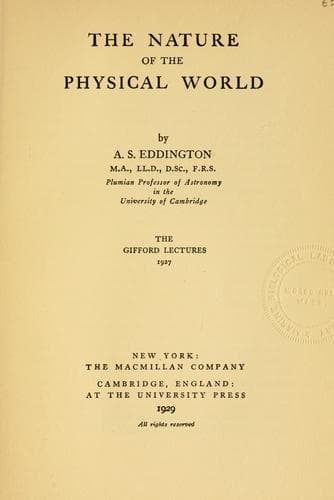
The nature of the physical worldEddington, Arthur Stanley, Sir
Philosophy
The nature of the physical world
Eddington, Arthur Stanley, Sir
Physics -- Philosophy; Science -- Philosophy
Transition to a New Theory. By 1925 the machinery of current
theory had developed another flaw and was urgently calling for
reconstruction; Bohr’s model of the atom had quite definitely broken
down. This is the model, now very familiar, which pictures the atom
as a kind of solar system with a central positively charged nucleus
and a number of elecrons describing orbits about it like planets, the
important feature being that the possible orbits are limited by the
rules referred to on p. 190. Since each line in the spectrum of the
atom is emitted by the jump of an electron between two particular
[Pg 205]
orbits, the classification of the spectral lines must run parallel with
the classification of the orbits by their quantum numbers in the model.
When the spectroscopists started to unravel the various series of lines
in the spectra they found it possible to assign an orbit jump for every
line—they could say what each line meant in terms of the model. But
now questions of finer detail have arisen for which this correspondence
ceases to hold. One must not expect too much from a model, and it
would have been no surprise if the model had failed to exhibit minor
phenomena or if its accuracy had proved imperfect. But the kind of
trouble now arising was that only two orbit jumps were provided in
the model to represent three obviously associated spectral lines;
and so on. The model which had been so helpful in the interpretation
of spectra up to a point, suddenly became altogether misleading; and
spectroscopists were forced to turn away from the model and complete
their classification of lines in a way which ignored it. They continued
to speak of orbits and orbit jumps but there was no longer a complete
one-to-one correspondence with the orbits shown in the model.[35]
The time was evidently ripe for the birth of a new theory. The
situation then prevailing may be summarised as follows:
(1) The general working rule was to employ the classical laws with the
supplementary proviso that whenever anything of the nature of action
appears it must be made equal to , or sometimes to an integral
[Pg 206]
multiple of .
(2) The proviso often led to a self-contradictory use of the classical
theory. Thus in the Bohr atom the acceleration of the electron in
its orbit would be governed by classical electrodynamics whilst its
radiation would be governed by the rule. But in classical
electrodynamics the acceleration and the radiation are indissolubly
connected.
(3) The proper sphere of classical laws was known. They are a form
taken by the more general laws in a limiting case, viz. when the number
of quanta concerned is very large. Progress in the investigation of the
complete system of more general laws must not be hampered by classical
conceptions which contemplate only the limiting case.
Public-domain text, read in full here on John Shaqi.
Reviews
Reviews
No reviews yet
Be the first to share your thoughts on this work.
Elsewhere in the archive
Join the Discussion
Join the discussion
Sign in to leave a comment or review.
Sign InorCreate an account