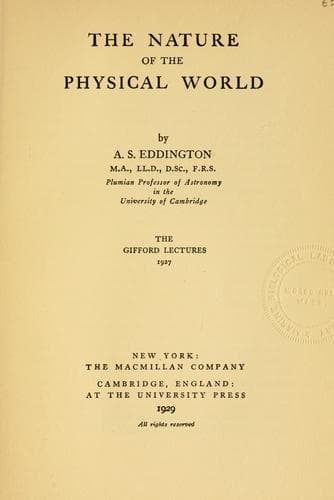
The nature of the physical worldEddington, Arthur Stanley, Sir
Philosophy
The nature of the physical world
Eddington, Arthur Stanley, Sir
Physics -- Philosophy; Science -- Philosophy
“What is Mr. X?” In the light of these considerations let
us now see what we can make of the question, What is Mr. X? I must
undertake the inquiry single-handed; I cannot avail myself of your
collaboration without first answering or assuming an answer to the
equally difficult question, What are you? Accordingly the whole inquiry
must take place in the domain of my own consciousness. I find there
certain data purporting to relate to this unknown X; and I can (by
using powers which respond to my volition) extend the data, i.e. I can
[Pg 269]
perform experiments on X. For example I can make a chemical analysis.
The immediate result of these experiments is the occurrence of certain
visual or olfactory sensations in my consciousness. Clearly it is a
long stride from these sensations to any rational inference about Mr.
X. For example, I learn that Mr. X has carbon in his brain, but the
immediate knowledge was of something (not carbon) in my own mind. The
reason why I, on becoming aware of something in my mind, can proceed
to assert knowledge of something elsewhere, is because there is a
systematic scheme of inference which can be traced from the one item
of knowledge to the other. Leaving aside instinctive or commonsense
inference—the crude precursor of scientific inference—the inference
follows a linkage, which can only be described symbolically, extending
from the point in the symbolic world where I locate myself to the point
where I locate Mr. X.
One feature of this inference is that I never discover what carbon
really is. It remains a symbol. There is carbon in my own brain-mind;
but the self-knowledge of my mind does not reveal this to me. I can
only know that the symbol for carbon must be placed there by following
a route of inference through the external world similar to that used
in discovering it in Mr. X; and however closely associated this carbon
may be with my thinking powers, it is as a symbol divorced from any
thinking capacity that I learn of its existence. Carbon is a symbol
definable only in terms of the other symbols belonging to the cyclic
scheme of physics. What I have discovered is that, in order that the
symbols describing the physical world may conform to the mathematical
formulae which they are designed to obey, it is necessary to place
[Pg 270]
the symbol for carbon (amongst others) in the locality of Mr. X. By
similar means I can make an exhaustive physical examination of Mr. X
and discover the whole array of symbols to be assigned to his locality.
Will this array of symbols give me the whole of Mr. X? There is not the
least reason to think so. The voice that comes to us over the telephone
wire is not the whole of what is at the end of the wire. The scientific
linkage is like the telephone wire; it can transmit just what it is
constructed to transmit and no more.
Public-domain text, read in full here on John Shaqi.
Reviews
Reviews
No reviews yet
Be the first to share your thoughts on this work.
Elsewhere in the archive
Join the Discussion
Join the discussion
Sign in to leave a comment or review.
Sign InorCreate an account