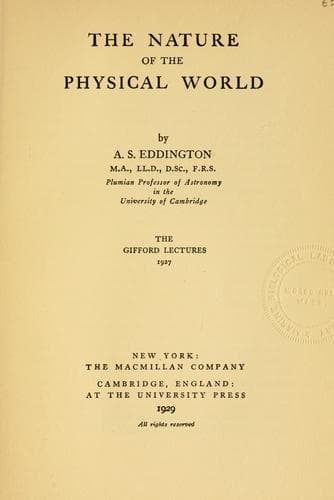
The nature of the physical worldEddington, Arthur Stanley, Sir
Philosophy
The nature of the physical world
Eddington, Arthur Stanley, Sir
Physics -- Philosophy; Science -- Philosophy
The external world of physics has been formulated as an answer to a
particular problem encountered in human experience. Officially the
scientist regards it as a problem which he just happened across, as
he might take up a cross-word problem encountered in a news-paper.
His sole business is to see that the problem is correctly solved. But
questions may be raised about a problem which play no part and need
not be considered in connection with the solving of the problem. The
extraneous question naturally raised about the problem of the external
world is whether there is some higher justification for embarking on
this world-solving competition rather than on other problems which
our experience might suggest to us. Just what kind of justification
[Pg 287]
the scientist would claim for his quest is not very clear, because it
is not within the province of science to formulate such a claim. But
certainly he makes claims which do not rest on the aesthetic perfection
of the solution or on material benefits derived from scientific
research. He would not allow his subject to be shoved aside in a
symposium on truth. We can scarcely say anything more definite than
that science claims a “halo” for its world.
If we are to find for the atoms and electrons of the external world
not merely a conventional reality but “reality (loud cheers)” we
must look not to the end but to the beginning of the quest. It is
at the beginning that we must find that sanction which raises these
entities above the mere products of an arbitrary mental exercise. This
involves some kind of assessment of the impulse which sets us forth
on the voyage of discovery. How can we make such assessment? Not by
any reasoning that I know of. Reasoning would only tell us that the
impulse might be judged by the success of the adventure—whether it
leads in the end to things which really exist and wear the halo in
their own right; it takes us to and fro like a shuttle along the chain
of inference in vain search for the elusive halo. But, legitimately
or not, the mind is confident that it can distinguish certain quests
as sanctioned by indisputable authority. We may put it in different
ways the impulse to this quest is part of our very nature; it is the
expression of a purpose which has possession of us. Is this precisely
what we meant when we sought to affirm the reality of the external
world? It goes some way towards giving it a meaning but is scarcely the
full equivalent. I doubt if we really satisfy the conceptions behind
that demand unless we make the bolder hypothesis that the quest and
[Pg 288]
all that is reached by it are of worth in the eyes of an Absolute
Valuer.
Public-domain text, read in full here on John Shaqi.
Reviews
Reviews
No reviews yet
Be the first to share your thoughts on this work.
Elsewhere in the archive
Join the Discussion
Join the discussion
Sign in to leave a comment or review.
Sign InorCreate an account