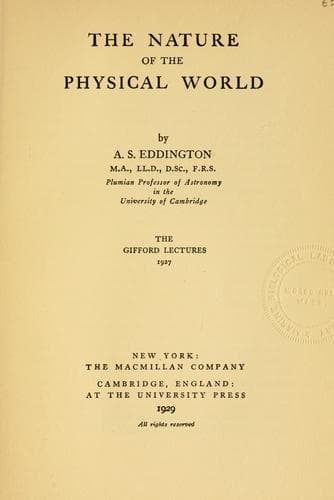
The nature of the physical worldEddington, Arthur Stanley, Sir
Philosophy
The nature of the physical world
Eddington, Arthur Stanley, Sir
Physics -- Philosophy; Science -- Philosophy
Physical Illustrations. If the reader is unconvinced that
there can be anything indefinite in the question whether a thing
exists or not, let him glance at the following problem. Consider a
distribution of matter in Einstein’s spherical “finite but unbounded”
space. Suppose that the matter is so arranged that every particle has
an exactly similar particle at its antipodes. (There is some reason
to believe that the matter would necessarily have this arrangement
in consequence of the law of gravitation; but this is not certain.)
Each group of particles will therefore be exactly like the antipodal
group not only in its structure and configuration but in its entire
surroundings; the two groups will in fact be indistinguishable by any
possible experimental test. Starting on a journey round the spherical
world we come across a group , and then after going half round we
come to an exactly similar group indistinguishable by any test;
another half circle again brings us to an exactly similar group, which,
however, we decide is the original group . Now let us ponder a
little. We realise that in any case by going on far enough we come
back to the same group. Why do we not accept the obvious conclusion
that this happened when we reached ; everything was exactly as
though we had reached the starting-point again? We have encountered
a succession of precisely similar phenomena but for some arbitrary
reason have decided that only the alternate ones are really
the same. There is no difficulty in identifying all of them; in that
case the space is “elliptical” instead of “spherical”. But which is
[Pg 290]
the real truth? Disregard the fact that I introduced and
to you as though they were not the same particles, because that begs
the question; imagine that you have actually had this adventure in a
world you had not been told about. You cannot find out the answer. Can
you conceive what the question means? I cannot. All that turns on the
answer is whether we shall provide two separate haloes for and
or whether one will suffice.
Descriptions of the phenomena of atomic physics have an extraordinary
vividness. We see the atoms with their girdles of circulating electrons
darting hither and thither, colliding and rebounding. Free electrons
torn from the girdles hurry away a hundred times faster, curving
sharply round the atoms with side slips and hairbreadth escapes.
The truants are caught and attached to the girdles and the escaping
energy shakes the aether into vibration. X-rays impinge on the atoms
and toss the electrons into higher orbits. We see these electrons
falling back again, sometimes by steps, sometimes with a rush, caught
in a cul-de-sac of metastability, hesitating before “forbidden
passages”. Behind it all the quantum regulates each change with
mathematical precision. This is the sort of picture that appeals to our
understanding—no insubstantial pageant to fade like a dream.
Public-domain text, read in full here on John Shaqi.
Reviews
Reviews
No reviews yet
Be the first to share your thoughts on this work.
Elsewhere in the archive
Join the Discussion
Join the discussion
Sign in to leave a comment or review.
Sign InorCreate an account