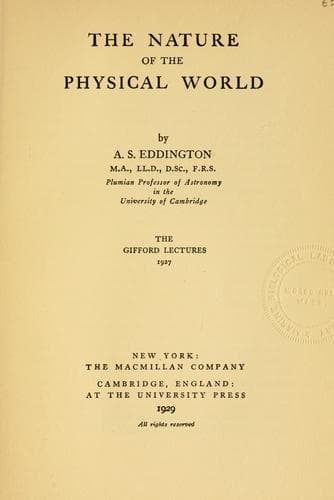
The nature of the physical worldEddington, Arthur Stanley, Sir
Philosophy
The nature of the physical world
Eddington, Arthur Stanley, Sir
Physics -- Philosophy; Science -- Philosophy
In the old conflict between freewill and predestination it has seemed
hitherto that physics comes down heavily on the side of predestination.
Without making extravagant claims for the scope of natural law, its
moral sympathy has been with the view that whatever the future may
bring forth is already foretold in the configurations of the past—
Yea, the first Morning of Creation wrote
What the Last Dawn of Reckoning shall read.
I am not so rash as to invade Scotland with a solution of a problem
which has rent her from the synod to the cottage. Like most other
people, I suppose, I think it incredible that the wider scheme of
Nature which includes life and consciousness can be completely
predetermined; yet I have not been able to form a satisfactory
conception of any kind of law or causal sequence which shall be other
than deterministic. It seems contrary to our feeling of the dignity of
the mind to suppose that it merely registers a dictated sequence of
thoughts and emotions; but it seems equally contrary to its dignity to
put it at the mercy of impulses with no causal antecedents. I shall
not deal with this dilemma. Here I have to set forth the position of
physical science on this matter so far as it comes into her territory.
It does come into her territory, because that which we call human
will cannot be entirely dissociated from the consequent motions of
the muscles and disturbance of the material world. On the scientific
[Pg 294]
side a new situation has arisen. It is a consequence of the advent of
the quantum theory that physics is no longer pledged to a scheme of
deterministic law. Determinism has dropped out altogether in the
latest formulations of theoretical physics and it is at least open to
doubt whether it will ever be brought back.
The foregoing paragraph is from the manuscript of the original lecture
delivered in Edinburgh. The attitude of physics at that time was one
of indifference to determinism. If there existed a scheme of strictly
causal law at the base of phenomena the search for it was not at
present practical politics, and meanwhile another ideal was being
pursued. The fact that a causal basis had been lost sight of in the new
theories was fairly well known; many regretted it, and held that its
restoration was imperative.[47]
Public-domain text, read in full here on John Shaqi.
Reviews
Reviews
No reviews yet
Be the first to share your thoughts on this work.
Elsewhere in the archive
Join the Discussion
Join the discussion
Sign in to leave a comment or review.
Sign InorCreate an account