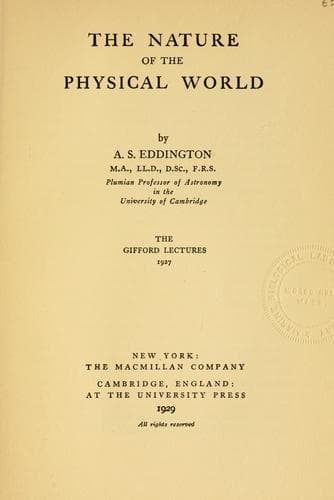
The nature of the physical worldEddington, Arthur Stanley, Sir
Philosophy
The nature of the physical world
Eddington, Arthur Stanley, Sir
Physics -- Philosophy; Science -- Philosophy
The lever in a signal box is moved and the signal drops. We can point
out the relation of constraint which associates the positions of lever
and signal; we can also find that the movements are not synchronous,
and calculate the time-difference. But the laws of mechanics do not
ascribe an absolute sign to this time-difference; so far as they
are concerned we may quite well suppose that the drop of the signal
causes the motion of the lever. To settle which is the cause, we have
two options. We can appeal to the signalman who is confident that he
made the mental decision to pull the lever; but this criterion will
only be valid if we agree that there was a genuine decision between
two possible courses and not a mere mental registration of what was
already predetermined. Or we can appeal to secondary law which takes
note of the fact that there was more of the random element in the world
when the signal dropped than when the lever moved. But the feature
of secondary law is that it ignores strict causation; it concerns
itself not with what must happen but with what is likely to happen.
Thus distinction of cause and effect has no meaning in the closed
system of primary laws of physics; to get at it we have to break into
the scheme, introducing considerations of volition or of probability
which are foreign to it. This is rather analogous to the ten vanishing
coefficients of curvature which could only be recognised if the closed
[Pg 297]
system of the world were broken into by standards foreign to it.
For convenience I shall call the relation of effect to cause
causation, and the symmetrical relation which does not
distinguish between cause and effect causality. In primary
physics causality has completely replaced causation. Ideally the
whole world past and future is connected into a deterministic scheme
by relations of causality. Up till very recently it was universally
held that such a determinate scheme must exist (possibly subject to
suspension by supernatural agencies outside the scope of physics);
we may therefore call this the “orthodox” view. It was, of course,
recognised that we were only acquainted with part of the structure of
this causal scheme, but it was the settled aim of theoretical physics
to discover the whole.
This replacement in orthodox science of causation by causality is
important in one respect. We must not let causality borrow an intuitive
sanction which really belongs only to causation. We may think we have
an intuition that the same cause cannot have two alternative effects;
but we do not claim any intuition that the same effect may not spring
from two alternative causes. For this reason the assumption of a rigid
determinateness enforced by relations of causality cannot be said to be
insisted on by intuition.
What is the ground for so much ardent faith in the orthodox hypothesis
that physical phenomena rest ultimately on a scheme of completely
deterministic laws? I think there are two reasons—
Public-domain text, read in full here on John Shaqi.
Reviews
Reviews
No reviews yet
Be the first to share your thoughts on this work.
Elsewhere in the archive
Join the Discussion
Join the discussion
Sign in to leave a comment or review.
Sign InorCreate an account