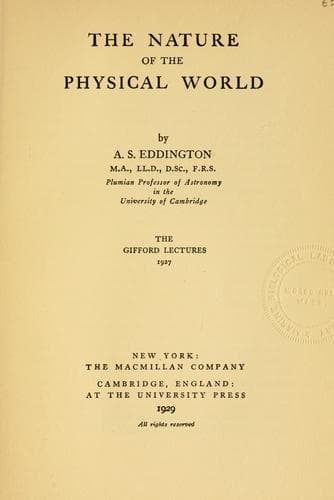
The nature of the physical worldEddington, Arthur Stanley, Sir
Philosophy
The nature of the physical world
Eddington, Arthur Stanley, Sir
Physics -- Philosophy; Science -- Philosophy
Conviction. Through fourteen chapters you have followed with me
the scientific approach to knowledge. I have given the philosophical
reflections as they have naturally arisen from the current scientific
conclusions, I hope without distorting them for theological ends. In
the present chapter the standpoint has no longer been predominantly
scientific; I started from that part of our experience which is not
within the scope of a scientific survey, or at least is such that
the methods of physical science would miss the significance that we
consider it essential to attribute to it. The starting-point of belief
in mystical religion is a conviction of significance or, as I have
called it earlier, the sanction of a striving in the consciousness.
This must be emphasised because appeal to intuitive conviction of this
kind has been the foundation of religion through all ages and I do
not wish to give the impression that we have now found something new
and more scientific to substitute. I repudiate the idea of proving
the distinctive beliefs of religion either from the data of physical
science or by the methods of physical science. Presupposing a mystical
religion based not on science but (rightly or wrongly) on a self-known
experience accepted as fundamental, we can proceed to discuss the
various criticisms which science might bring against it or the possible
conflict with scientific views of the nature of experience equally
originating from self-known data.
It is necessary to examine further the nature of the conviction from
which religion arises; otherwise we may seem to be countenancing a
blind rejection of reason as a guide to truth. There is a hiatus in
reasoning, we must admit; but it is scarcely to be described as a
rejection of reasoning. There is just the same hiatus in reasoning
about the physical world if we go back far enough. We can only reason
[Pg 334]
from data and the ultimate data must be given to us by a non-reasoning
process—a self-knowledge of that which is in our consciousness. To
make a start we must be aware of something. But that is not sufficient;
we must be convinced of the significance of that awareness. We are
bound to claim for human nature that, either of itself or as inspired
by a power beyond, it is capable of making legitimate judgments of
significance. Otherwise we cannot even reach a physical world.[49]
Accordingly the conviction which we postulate is that certain states of
awareness in consciousness have at least equal significance with those
which are called sensations. It is perhaps not irrelevant to note that
time by its dual entry into our minds (p. 51) to some extent bridges
the gap between sense-impressions and these other states of awareness.
Amid the latter must be found the basis of experience from which a
spiritual religion arises. The conviction is scarcely a matter to be
argued about, it is dependent on the forcefulness of the feeling of
awareness.
Public-domain text, read in full here on John Shaqi.
Reviews
Reviews
No reviews yet
Be the first to share your thoughts on this work.
Elsewhere in the archive
Join the Discussion
Join the discussion
Sign in to leave a comment or review.
Sign InorCreate an account