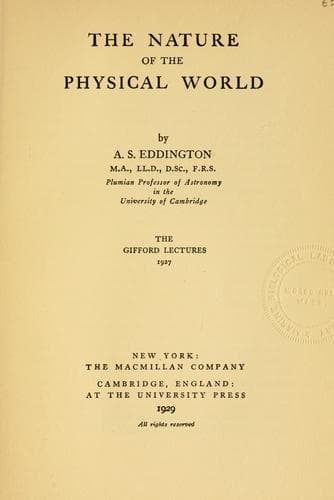
The nature of the physical worldEddington, Arthur Stanley, Sir
Philosophy
The nature of the physical world
Eddington, Arthur Stanley, Sir
Physics -- Philosophy; Science -- Philosophy
The critical reader will probably pursue his objection. “Are you
not being paradoxical when you say that a molecular bombardment of
the train can cause an acceleration of the station—and in fact of
the earth and the rest of the universe? To put it mildly, relative
acceleration is a relation with two ends to it, and we may at first
seem to have an option which end we shall grasp it by; but in this case
the causation (molecular bombardment) clearly indicates the right end
to take hold of, and you are merely spinning paradoxes when you insist
on your liberty to take hold of the other.”
If there is an absurdity in taking hold of the wrong end of the
relation it has passed into our current speech and thought. Your
suggestion is in fact more revolutionary than anything Einstein has
[Pg 132]
ventured to advocate. Let us take the problem of a falling stone.
There is a relative acceleration of 32 feet per second per second—of
the stone relative to ourselves or of ourselves relative to the
stone. Which end of the relation must we choose? The one indicated by
molecular bombardment? Well, the stone is not bombarded; it is falling
freely in vacuo. But we are bombarded by the molecules of the
ground on which we stand. Therefore it is we who have the acceleration;
the stone has zero acceleration, as the man in the lift supposed. Your
suggestion makes out the frame of the man in the lift to be the only
legitimate one; I only went so far as to admit it to an equality with
our own customary frame.
Your suggestion would accept the testimony of the drunken man who
explained that “the paving-stone got up and hit him” and dismiss the
policeman’s account of the incident as “merely spinning paradoxes”.
What really happened was that the paving-stone had been pursuing the
man through space with ever-increasing velocity, shoving the man
in front of it so that they kept the same relative position. Then,
through an unfortunate wobble of the axis of the man’s body, he
failed to increase his speed sufficiently, with the result that the
paving-stone overtook him and came in contact with his head. That,
please understand, is your suggestion; or rather the suggestion which I
have taken the liberty of fathering on you because it is the outcome of
a very common feeling of objection to the relativity theory. Einstein’s
position is that whilst this is a perfectly legitimate way of looking
at the incident the more usual account given by the policeman is also
legitimate; and he endeavours like a good magistrate to reconcile them
both.
[Pg 133]
Time Geometry. Einstein’s law of gravitation controls a
geometrical quantity curvature in contrast to Newton’s law which
controls a mechanical quantity force. To understand the origin
of this geometrisation of the world in the relativity theory we must go
back a little.
Public-domain text, read in full here on John Shaqi.
Reviews
Reviews
No reviews yet
Be the first to share your thoughts on this work.
Elsewhere in the archive
Join the Discussion
Join the discussion
Sign in to leave a comment or review.
Sign InorCreate an account