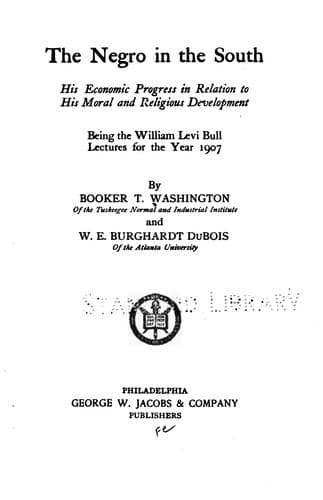
The Negro in the South: His Economic Progress in Relation to his Moral and Religious DevelopmentDu Bois, W. E. B. (William Edward Burghardt)
History
The Negro in the South: His Economic Progress in Relation to his Moral and Religious Development
Du Bois, W. E. B. (William Edward Burghardt)
African Americans -- Southern States
So, too, in Virginia the Haytian revolt and the attempted insurrection
under Gabriel in 1800 led to the Act of 1804, which forbade all
evening meetings of slaves. This was modified in 1805 so as to allow a
slave, in company with a white person, to listen to a white minister
in the evening. A master was "allowed" to employ a religious teacher
for his slaves. Mississippi passed similar restrictions.
By 1822 the rigor of the South Carolina laws in regard to Negro
meetings had abated, especially in a city like Charleston, and one of
the results was the Vesey plot.
"The sundry religious classes or congregations, with Negro leaders or
local preachers, into which were formed the Negro members of the
various churches of Charleston, furnished Vesey with the first
rudiments of an organization, and at the same time with a singularly
safe medium for conducting his underground agitation. It was
customary, at that time, for these Negro congregations to meet for
purposes of worship entirely free from the presence of whites. Such
meetings were afterward forbidden to be held except in the presence of
at least one representative of the dominant race, but during the three
or four years prior to the year 1822 they certainly offered Denmark
Vesey regular, easy, and safe opportunity for preaching his gospel of
liberty and hate. And we are left in no doubt whatever in regard to
the uses to which he put those gatherings of blacks.
"Like many of his race, he possessed the gift of gab, as the silver in
the tongue and the gold in the full or thick-lipped mouth are
oftentimes contemptuously characterized. And, like many of his race,
he was a devoted student of the Bible, to whose interpretation he
brought, like many other Bible students not confined to the Negro
race, a good deal of imagination and not a little of superstition,
which, with some natures, is perhaps but another name for the desires
of the heart.
"Thus equipped, it is no wonder that Vesey, as he pored over the Old
Testament scriptures, found many points of similitude in the history
of the Jews and that of the slaves in the United States. They were
both peculiar peoples. They were both Jehovah's peculiar peoples, one
in the past, the other in the present. And it seemed to him that as
Jehovah bent His ear, and bared His arm once in behalf of the one, so
would He do the same for the other. It was all vividly real to his
thought, I believe, for to his mind thus had said the Lord.
Public-domain text, read in full here on John Shaqi.
Reviews
Reviews
No reviews yet
Be the first to share your thoughts on this work.
Join the Discussion
Join the discussion
Sign in to leave a comment or review.
Sign InorCreate an account