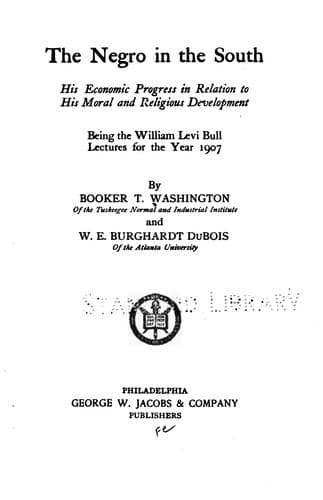
The Negro in the South: His Economic Progress in Relation to his Moral and Religious DevelopmentDu Bois, W. E. B. (William Edward Burghardt)
History
The Negro in the South: His Economic Progress in Relation to his Moral and Religious Development
Du Bois, W. E. B. (William Edward Burghardt)
African Americans -- Southern States
"He ransacked the Bible for apposite and terrible texts whose commands
in the olden times, to the olden people, were no less imperative upon
the new times and the new people. This new people were also commanded
to arise and destroy their enemies and the city in which they dwelt,
'both man and woman, young and old, with the edge of the sword.'
Believing superstitiously as he did in the stern and Nemesis-like God
of the Old Testament he looked confidently for a day of vengeance and
retribution for the blacks. He felt, I doubt not, something peculiarly
applicable to his enterprise and intensely personal to himself in the
stern and exultant prophecy of Zachariah, fierce and sanguinary words,
which were constantly in his mouth: 'Then shall the Lord go forth and
fight against those nations as when He fought in the day of battle.'
According to Vesey's lurid exegesis 'those nations' in the text meant
beyond peradventure the cruel masters, and Jehovah was to go forth to
fight them for the poor slaves and on whichever side fought that day
the Almighty God on that side would assuredly rest victory and
deliverance.
"It will not be denied that Vesey's plan contemplated the total
annihilation of the white population of Charleston. Nursing for many
dark years the bitter wrongs of himself and race had filled him
without doubt with a mad spirit of revenge and had given to him a
decided predilection for shedding the blood of his oppressors. But if
he intended to kill them to satisfy a desire for vengeance he intended
to do so also on broader ground. The conspirators, he argued, had no
choice in the matter, but were compelled to adopt a policy of
extermination by the necessity of their position. The liberty of the
blacks was in the balance of fate against the lives of the whites. He
could strike that balance in favor of the blacks only by the total
destruction of the whites. Therefore the whites, men, women, and
children, were doomed to death."[1]
Vesey's plot was well laid, but the conspirators were betrayed.
Less than ten years after this plot was discovered and Vesey and his
associates hanged, there broke out the Nat Turner insurrection in
Virginia. Turner was himself a preacher.
"He was a Christian and a man. He was conscious that he was a Man and
not a 'thing'; therefore, driven by religious fanaticism, he undertook
a difficult and bloody task. Nathaniel Turner was born in Southampton
County, Virginia, October 2, 1800. His master was one Benjamin Turner,
a very wealthy and aristocratic man. He owned many slaves, and was a
cruel and exacting master. Young 'Nat' was born of slave parents, and
carried to his grave many of the superstitions and traits of his
father and mother. The former was a preacher, the latter a 'mother in
Israel.' Both were unlettered but, nevertheless, very pious people.
Public-domain text, read in full here on John Shaqi.
Reviews
Reviews
No reviews yet
Be the first to share your thoughts on this work.
Join the Discussion
Join the discussion
Sign in to leave a comment or review.
Sign InorCreate an account