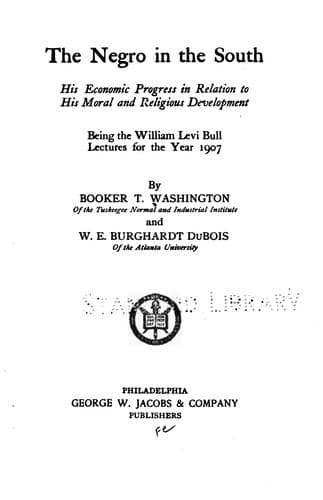
The Negro in the South: His Economic Progress in Relation to his Moral and Religious DevelopmentDu Bois, W. E. B. (William Edward Burghardt)
History
The Negro in the South: His Economic Progress in Relation to his Moral and Religious Development
Du Bois, W. E. B. (William Edward Burghardt)
African Americans -- Southern States
Thus slowly, surely, the slave, in the persons of such exceptional
men, appearing here and there at rare intervals, was persistently
stretching upward. The Negroes bade fair in time to have their
leaders. The new democratic evangelism began to encourage this, and
then came the difficulty--the inevitable ethical paradox.
The good men of the South recognized the needs of the slaves. Here and
there Negro ministers were arising. What now should be the policy? On
the part of the best thinkers it seemed as if men might strive here,
in spite of slavery, after brotherhood; that the slaves should be
proselyted, taught religion, admitted to the churches, and,
notwithstanding their civil station, looked upon as the spiritual
brothers of the white communicants. Much was done to make this true.
The conditions improved in a great many respects, but no sooner was
there a systematic effort to teach the slaves, even though that
teaching was confined to elementary religion, than the various things
followed that must follow all intellectual awakenings.
We have had the same thing in our day. A few Negroes of the South have
been taught, they consequently have begun to think, they have begun to
assert themselves, and suddenly men are face to face with the fact
that either one of two things must happen--either they must stop
teaching or these people are going to be men, not serfs or slaves. Not
only that, but to seek to put an awakening people back to sleep means
revolt. It meant revolt in the eighteenth century, when a series of
insurrections and disturbances frightened the South tremendously, not
so much by their actual extent as by the possibilities they suggested.
It was noticeable that many of these revolts were led by preachers.
The revolution in Hayti greatly stirred the South and induced South
Carolina to declare in 1800:
"It shall not be lawful for any number of slaves, free Negroes,
mulattoes, or mestizoes, even in company with white persons, to meet
together and assemble for the purpose of mental instruction or
religious worship either before the rising of the sun or after the
going down of the same. And all magistrates, sheriffs, militia
officers, etc., etc., are hereby vested with power, etc., for
dispersing such assemblies."
On petition of the white churches the rigor of this law was slightly
abated in 1803 by a modification which forbade any person, before nine
o'clock in the evening, "to break into a place of meeting wherein
shall be assembled the members of any religious society in this State,
provided a majority of them shall be white persons, or otherwise to
disturb their devotions unless such persons, etc., so entering said
place (of worship) shall first have obtained from some magistrate,
etc., a warrant, etc., in case a magistrate shall be then actually
within a distance of three miles from such place of meeting; otherwise
the provisions, etc. (of the Act of 1800) to remain in full force."
Public-domain text, read in full here on John Shaqi.
Reviews
Reviews
No reviews yet
Be the first to share your thoughts on this work.
Join the Discussion
Join the discussion
Sign in to leave a comment or review.
Sign InorCreate an account