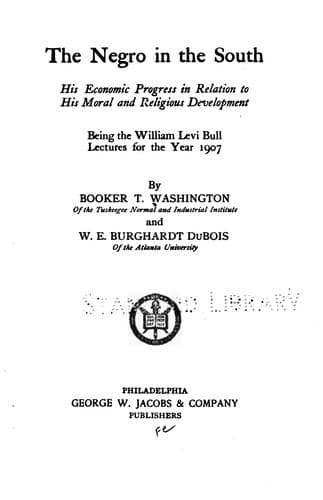
The Negro in the South: His Economic Progress in Relation to his Moral and Religious DevelopmentDu Bois, W. E. B. (William Edward Burghardt)
History
The Negro in the South: His Economic Progress in Relation to his Moral and Religious Development
Du Bois, W. E. B. (William Edward Burghardt)
African Americans -- Southern States
"The mother began when Nat was quite young to teach him that he was
born, like Moses, to be the deliverer of his race. She would sing to
him snatches of wild, rapturous songs and repeat portions of prophecy
she had learned from the preachers of those times. Nat listened with
reverence and awe, and believed everything his mother said. He imbibed
the deep religious character of his parents, and soon manifested a
desire to preach. He was solemnly set apart to 'the gospel ministry'
by his father, the church, and visiting preachers. He was quite low in
stature, dark, and had the genuine African features. His eyes were
small but sharp, and gleamed like fire when he was talking about his
'mission' or preaching from some prophetic passage of scripture. It is
said that he never laughed. He was a dreamy sort of a man, and avoided
the crowd.
"Like Moses he lived in the solitudes of the mountains and brooded
over the condition of his people. There was something grand to him in
the rugged scenery that nature had surrounded him with. He believed
that he was a prophet, a leader raised up by God to burst the bolts of
the prison-house and set the oppressed free. The thunder, the hail,
the storm-cloud, the air, the earth, the stars, at which he would sit
and gaze half the night all spake the language of the God of the
oppressed. He was seldom seen in a large company, and never drank a
drop of ardent spirits. Like John the Baptist, when he had delivered
his message, he would retire to the fastness of the mountain or seek
the desert, where he could meditate upon his great work."
In the impression of the Richmond _Enquirer_ of the 30th of August,
1831, the first editorial or leader is under the caption of "The
Banditte." The editor says:
"They remind one of a parcel of blood-thirsty wolves rushing down from
the Alps; or, rather, like a former incursion of the Indians upon the
white settlements. Nothing is spared; neither age nor sex
respected--the helplessness of women and children pleads in vain for
mercy.... The case of Nat Turner warns us. No black man ought to be
permitted to turn preacher through the country. The law must be
enforced, or the tragedy of Southampton appeals to us in vain."
Mr. Gray, the man to whom Turner made his confession before dying,
said:
Public-domain text, read in full here on John Shaqi.
Reviews
Reviews
No reviews yet
Be the first to share your thoughts on this work.
Join the Discussion
Join the discussion
Sign in to leave a comment or review.
Sign InorCreate an account