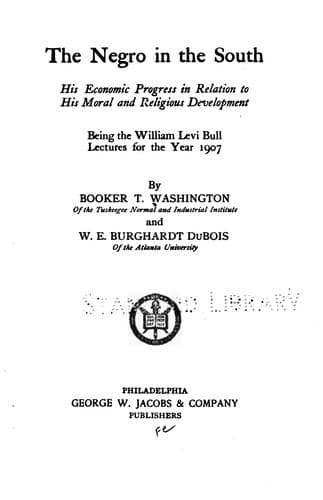
The Negro in the South: His Economic Progress in Relation to his Moral and Religious DevelopmentDu Bois, W. E. B. (William Edward Burghardt)
History
The Negro in the South: His Economic Progress in Relation to his Moral and Religious Development
Du Bois, W. E. B. (William Edward Burghardt)
African Americans -- Southern States
Virginia declared, in 1831, that neither slaves nor free Negroes might
preach, nor could they attend religious service at night without
permission. In North Carolina slaves and free Negroes were forbidden
to preach, exhort or teach "in any prayer-meeting or other association
for worship where slaves of different families are collected together"
on penalty of not more than thirty-nine lashes. Maryland and Georgia
had similar laws. The Mississippi law of 1831 said: It is "unlawful
for any slave, free Negro, or mulatto to preach the gospel" upon pain
of receiving thirty-nine lashes upon the naked back of the
presumptuous preacher. If a Negro received written permission from his
master he might preach to the Negroes in his immediate neighborhood,
providing six respectable white men, owners of slaves, were present.
In Alabama the law of 1832 prohibited the assembling of more than five
male slaves at any place off the plantation to which they belonged,
but nothing in the act was to be considered as forbidding attendance
at places of public worship held by white persons. No slave or free
person of color was permitted to "preach, exhort, or harangue any
slave or slaves, or free persons of color, except in the presence of
five respectable slaveholders, or unless the person preaching was
licensed by some regular body of professing Christians in the
neighborhood, to whose society or church the Negroes addressed
properly belonged."
In the District of Columbia the free Negroes began to leave white
churches in 1831 and to assemble in their own.
Thus it was that through the fear of insurrection, the economic press
of the new slavery that was arising, and the new significance of
slavery in the economics of the South, the strife for spiritual
brotherhood was given up. Slavery became distinctly a matter of race
and not of status. Long years before, the white servants had been
freed and only black servants were left; now social condition came to
be not simply a matter of slavery but a matter of belonging to the
black race, so that even the free Negroes began to be disfranchised
and put into the caste system (see Note 23).
A new adjustment of ethics and religion had to be made to meet this
new situation, and in the adjustment, no matter what might be said or
thought, the Negro and slavery had to be the central thing.
In the adjustment of religion and ethics that was made for the new
slavery, under the cotton kingdom, there was in the first place a
distinct denial of human brotherhood. These black men were not men in
the sense that white men were men. They were different--different in
kind, different in origin; they had different diseases (see Note 24);
they had different feelings; they were not to be treated the same;
they were not looked upon as the same; they were altogether apart and,
while perhaps they had certain low sensibilities and aspirations, yet
so far as this world is concerned, there could be with them neither
human nor spiritual brotherhood.
Public-domain text, read in full here on John Shaqi.
Reviews
Reviews
No reviews yet
Be the first to share your thoughts on this work.
Join the Discussion
Join the discussion
Sign in to leave a comment or review.
Sign InorCreate an account