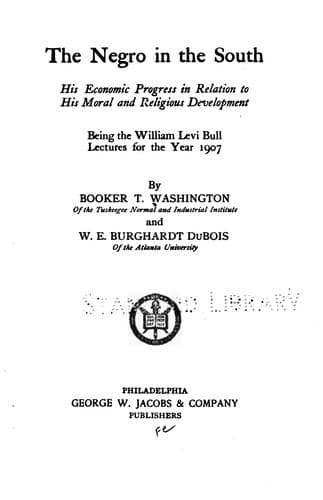
The Negro in the South: His Economic Progress in Relation to his Moral and Religious DevelopmentDu Bois, W. E. B. (William Edward Burghardt)
History
The Negro in the South: His Economic Progress in Relation to his Moral and Religious Development
Du Bois, W. E. B. (William Edward Burghardt)
African Americans -- Southern States
The only status that they could possibly occupy was the status of
slaves. They could not get along as freemen; they could not work as
freemen; it was utterly unthinkable that people should live with them
free. This was the philosophy that was worked out gradually, with
exceptions here and there, and that was thought through, written on,
preached from the pulpits and taught in the homes, until people in the
South believed it as they believed the rising and the setting of the
sun.
As this became more and more the orthodox ethical opinion, heretics
appeared in the land as they always do. But intolerance and anathema
met them. In community after community there was a demand for
orthodoxy on this one burning question of the economic and religious
South, and the heretics were driven out. The Quakers left North
Carolina, the abolitionists either left Virginia or ceased to talk,
and throughout the South those people who dared to think otherwise
were left silent or dead (see Note 25).
So long as slavery was an economic success this orthodoxy was all
powerful; when signs of economic distress appeared it became
intolerant and aggressive. A great moral battle was impending in the
South, but political turmoil and a development of northern thought so
rapid as to be unintelligible in the South stopped this development
forcibly. War came and the hatred and moral bluntness incident to war,
and men crystallized in their old thought.
The matter now could no longer be argued and thought out, it became a
matter of tradition, of faith, of family and personal honor. There
grew up therefore after the war a new predicament; a new-old paradox.
Upon the whites hung the curse of the past; because they had not
settled their labor problem then, they must settle the problem now in
the face of upheaval and handicapped by the natural advance of the
world.
So after the war and even to this day, the religious and ethical life
of the South bows beneath this burden. Shrinking from facing the
burning ethical questions that front it unrelentingly, the Southern
Church clings all the more closely to the letter of a worn out
orthodoxy, while its inner truer soul crouches before and fears to
answer the problem of eight million black neighbors. It therefore
assiduously "preaches Christ crucified," in prayer meeting _patois_,
and crucifies "Niggers" in unrelenting daily life.
While the Church in the North, all too slowly but surely is struggling
up from the ashes of a childish faith in myth and miracle, and
beginning to preach a living gospel of civic virtue, peace and good
will and a crusade against lying, stealing and snobbery, the Southern
church for the most part is still murmuring of modes of "baptism,"
"infant damnation" and the "divine plan of creation."
Public-domain text, read in full here on John Shaqi.
Reviews
Reviews
No reviews yet
Be the first to share your thoughts on this work.
Join the Discussion
Join the discussion
Sign in to leave a comment or review.
Sign InorCreate an account