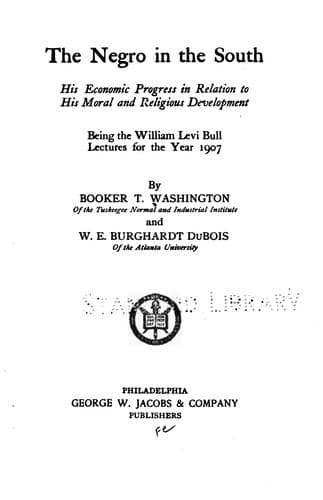
The Negro in the South: His Economic Progress in Relation to his Moral and Religious DevelopmentDu Bois, W. E. B. (William Edward Burghardt)
History
The Negro in the South: His Economic Progress in Relation to his Moral and Religious Development
Du Bois, W. E. B. (William Edward Burghardt)
African Americans -- Southern States
Left thus unguided the Negroes, with some help from such Northern
white churches as dared, began their own religious upbuilding (see
Note 27). They faced tremendous difficulties--lack of ministers,
money, and experience. Their churches could not be simply centres of
religious life--because in the poverty of their organized efforts all
united striving tended to centre in this one social organ. The Negro
Church consequently became a great social institution with some
ethical ideas but with those ethical ideas warped and changed and
perverted by the whole history of the past; with memories, traditions,
and rites of heathen worship, of intense emotionalism, trance, and
weird singing.
And above all, there brooded over and in the church the sense of all
their grievances. Whatsoever their own shortcomings might be, at least
they knew that they were not guilty of hypocrisy; they did not cry
"Whosoever will" and then brazenly ostracize half the world. They
knew that they opened their doors and hearts wide to all people that
really wanted to come in and they looked upon the white churches not
as examples but with a sort of silent contempt and a real inner
questioning of the genuineness of their Christianity.
On the other hand, so far as the white post-bellum Christian church is
concerned, I can conceive no more pitiable paradox than that of the
young white Christian in the South to-day who really believes in the
ethics of Jesus Christ. What can he think when he hangs upon his
church doors the sign that I have often seen, "All are welcome." He
knows that half the population of his city would not dare to go inside
that church. Or if there was any fellowship between Christians, white
and black, it would be after the manner explained by a white
Mississippi clergyman in all seriousness: "The whites and Negroes
understand each other here perfectly, sir, perfectly; if they come to
my church they take a seat in the gallery. If I go to theirs, they
invite me to the front pew or the platform."
Once in Atlanta a great revival was going on in a prominent white
church. The people were at fever heat, the minister was preaching and
calling "Come to Jesus." Up the aisle tottered an old black man--he
was an outcast, he had wandered in there aimlessly off the streets,
dimly he had comprehended this call and he came tottering and swaying
up the aisle. What was the result? It broke up the revival. There was
no disturbance; he was gently led out, but that sudden appearance of a
black face spoiled the whole spirit of the thing and the revival was
at an end.
Who can doubt that if Christ came to Georgia to-day one of His first
deeds would be to sit down and take supper with black men, and who can
doubt the outcome if He did?
Public-domain text, read in full here on John Shaqi.
Reviews
Reviews
No reviews yet
Be the first to share your thoughts on this work.
Elsewhere in the archive
Join the Discussion
Join the discussion
Sign in to leave a comment or review.
Sign InorCreate an account