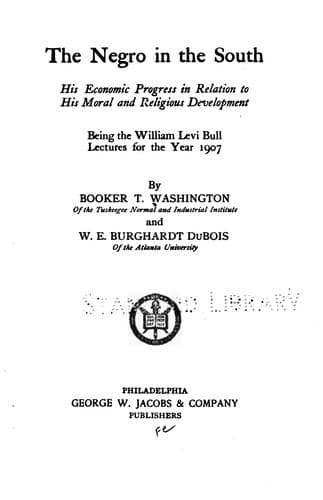
The Negro in the South: His Economic Progress in Relation to his Moral and Religious DevelopmentDu Bois, W. E. B. (William Edward Burghardt)
History
The Negro in the South: His Economic Progress in Relation to his Moral and Religious Development
Du Bois, W. E. B. (William Edward Burghardt)
African Americans -- Southern States
It is this tremendous paradox of a Christianity that theoretically
opens the church to all men and yet closes it forcibly and insultingly
in the face of black men and that does this not simply in the visible
church but even more harshly in the spiritual fellowship of human
souls--it is this that makes the ethical and religious problem in the
South to-day of such tremendous importance, and that gives rise to the
one thing which it seems to me is the most difficult in the Southern
situation and that is, the tendency to deny the truth, the tendency to
lie when the real situation comes up because the truth is too hard to
face. This lying about the situation of the South has not been simply
a political subterfuge against the dangers of ignorance, but is a sort
of gasping inner revolt against acknowledging the real truth of the
ethical conviction which every true Southerner must feel, namely: that
the South is eternally and fundamentally wrong on the plain straight
question of the equality of souls before God--of the inalienable
rights of all men.
Here are men--they are aspiring, they are struggling piteously
forward, they have frequent instances of ability, there is no doubt as
to the tremendous strides which certain classes of Negroes have
made--how shall they be treated? That they should be treated as men,
of course, the best class of Southerners know and sometimes
acknowledge. And yet they believe, and believe with fierce conviction,
that it is impossible to treat Negroes as men, and still live with
them. Right there is the paradox which they face daily and which is
daily stamping hypocrisy upon their religion and upon their land.
Their irresistible impulse in this awful dilemma is to point to and
emphasize the Negro's degradation, even though they know that it is
not the degraded Negro whom they most fear, ostracize, and fight to
keep down, but rather the rising, ambitious Negro.
If my own city of Atlanta had offered it to-day the choice between 500
Negro college graduates--forceful, busy, ambitious men of property and
self-respect, and 500 black cringing vagrants and criminals, the
popular vote in favor of the criminals would be simply overwhelming.
Why? because they want Negro crime? No, not that they fear Negro crime
less, but that they fear Negro ambition and success more. They can
deal with crime by chain-gang and lynch law, or at least they think
they can, but the South can conceive neither machinery nor place for
the educated, self-reliant, self-assertive black man.
Are a people pushed to such moral extremities, the ones whose
level-headed, unbiased statements of fact concerning the Negro can be
relied upon? Do they really know the Negro? Can the nation expect of
them the poise and patience necessary for the settling of a great
social problem?
Public-domain text, read in full here on John Shaqi.
Reviews
Reviews
No reviews yet
Be the first to share your thoughts on this work.
Elsewhere in the archive
Join the Discussion
Join the discussion
Sign in to leave a comment or review.
Sign InorCreate an account