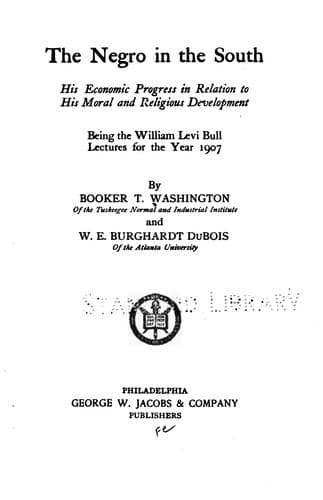
The Negro in the South: His Economic Progress in Relation to his Moral and Religious DevelopmentDu Bois, W. E. B. (William Edward Burghardt)
History
The Negro in the South: His Economic Progress in Relation to his Moral and Religious Development
Du Bois, W. E. B. (William Edward Burghardt)
African Americans -- Southern States
Not only is there then this initial falseness when the South excuses
its ethical paradox by pointing to the low condition of the Negro
masses, but there is also a strange blindness in failing to see that
every pound of evidence to prove the present degradation of black men
but adds to the crushing weight of indictment against their past
treatment of this race.
A race is not made in a single generation. If they accuse Negro women
of lewdness and Negro men of monstrous crime, what are they doing but
advertising to the world the shameless lewdness of those Southern men
who brought millions of mulattoes into the world, and whose deeds
throughout the South and particularly in Virginia, the mother of
slavery, have left but few prominent families whose blood does not
to-day course in black veins? Suppose to-day Negroes do steal; who
was it that for centuries made stealing a virtue by stealing their
labor? Have not laziness and listlessness always been the followers of
slavery? If these ten millions are ignorant by whose past law and
mandate and present practice is this true?
The truth then cannot be controverted. The present condition of the
Negro in America is better than the history of slavery proves we might
reasonably expect. With the help of his friends, North and South, and
despite the bitter opposition of his foes, South and North, he has
bought twelve million acres of land, swept away two-thirds of his
illiteracy, organized his church, and found leadership and articulate
voice. Yet despite this the South, Christian and unchristian, with
only here and there an exception, still stands like a rock wall and
says: Negroes are not men and must not be treated as men.
When now the world faces such an absolute ethical contradiction, the
truth is nearer than it seems.
It stands to-day perfectly clear and plain despite all sophistication
and false assumption: If the contention of the South is true--that
Negroes cannot by reason of hereditary inferiority take their places
in modern civilization beside white men, then the South owes it to the
world and to its better self to give the Negro every chance to prove
this. To make the assertion dogmatically and then resort to all means
which retard and restrict Negro development is not simply to stand
convicted of insincerity before the civilized world, but, far worse
than that, it is to make a nation of naturally generous, honest people
to sit humiliated before their own consciences.
Public-domain text, read in full here on John Shaqi.
Reviews
Reviews
No reviews yet
Be the first to share your thoughts on this work.
Elsewhere in the archive
Join the Discussion
Join the discussion
Sign in to leave a comment or review.
Sign InorCreate an account