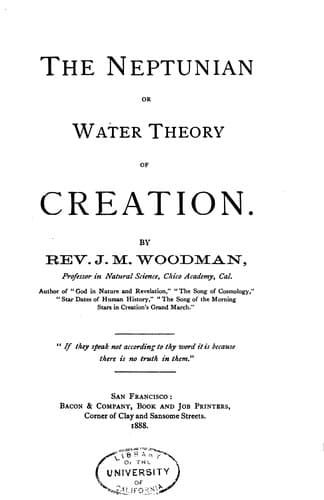
The Neptunian, or Water Theory of CreationWoodman, J. M.
Religion
The Neptunian, or Water Theory of Creation
Woodman, J. M.
Bible and science; Creation; Religion and science
Up to the Carboniferous time of deposit, the air had never been
sufficiently cleared of its dark clouds of deadly gases, to admit
sunshine on the earth. Vegetation had not reached a climax. No mention
is to be made of animals existing, until this climax is reached. It will
be reached when the sun shall have taken off the “swaddling band” of her
childhood, and depositing the same, as coal, in the earth, shall give
the earth a clothing of flowers. Non-flowering plants are evening, the
contrast will be the flowering plant in the sunshine.
1. By figure of metonymy, again he traced the progress of deposits
through the sun, which God had made, with the moon and stars. The labor
of the sun to clear the atmosphere, calling for immediate help of God,
was long and persevering. Poetically, the narrative is enriched by this
elegant figure, in putting cause for effect. As now from the earth for
the first time he beholds the clear sunlight, he doubtless is reminded,
that in mentioning the creation of this center of attraction in our
system, he had given a name which indicated a specific property of the
sun, viz, light; whereas it also had heat and force.
Now, calling it by a generic name, and remembering also that in
describing the origin of Earth no mention had been made of the rest of
the heavens, he incidentally mentions that God made them all, without
attempting the individual history of either. His mission is to trace in
progress the contrasting changes of God’s work in the Earth. And to his
text he adheres.
Since the sun is the only source of permanent natural light within our
system, and since Moses had made light to contrast with the darkness of
chaos in the first day, it seems strange that any intelligent reader
should understand him to speak of the bringing into existence of the
great orb of light the fourth day. Shining in on the earth is all that
is noted.
Public-domain text, read in full here on John Shaqi.
Reviews
Reviews
No reviews yet
Be the first to share your thoughts on this work.
Join the Discussion
Join the discussion
Sign in to leave a comment or review.
Sign InorCreate an account