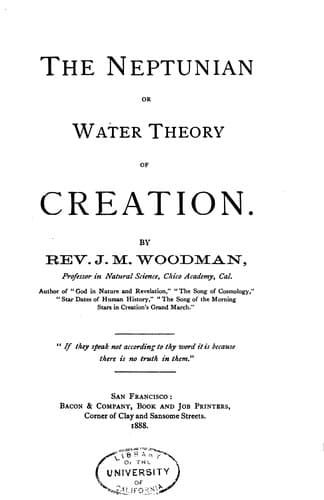
The Neptunian, or Water Theory of CreationWoodman, J. M.
Religion
The Neptunian, or Water Theory of Creation
Woodman, J. M.
Bible and science; Creation; Religion and science
2. Sir Charles Lyell, the great English geologist, gives us the process
by which sunlight was let in on the earth during the carboniferous age.
This age corresponds to the fourth day of Moses. The dark band of gases
intercepted the clear rays of sunlight, so that a somber hue of gray
covered the earth, as in twilight. Vegetation must slowly do the work of
depositing these gases, until diminished so that fire, or flame, could
be supported. Such was the resinous and oily nature of all vegetation of
that period, that a stroke of lightning might set the world on fire, to
burn for six months or a year. Some of the carbonated growth of the
forests would be hidden away beyond the reach of flame. In this
condition it would ripen into coal. But enough carbonic acid would
escape, to intercept the clear rays of the sun, and another period of
deposit would set in. In the Nova Scotia coal mines, alone, he had
noticed one hundred of these burnings, implying a long period of deposit
between each. It is thus the long ages struggled, to enable the sun to
kiss the vegetation into bloom. The widely scattered coal beds of this
period show that the whole earth was covered with a tropical forest.
Large veins of this coal are found in Greenland, Nova Zembla Island,
Tasmania, and the Melville Islands.
3. We have had subsequent periods of deposits of carbon in forests that
produced coal. But the coal formed since that age is generally soft. One
short coal period occurred this side the great upheavals of mountains.
This coal is found on the Pacific Coast, and yields only forty-four per
cent. carbon. The best coal had its origin before the flowers. In Moses’
prophetic vision of the work of the sun, he grasped certain points in
the future of astronomy.
4. He noticed the use an enlightened civilization would make of the
motions of the heavens. He noticed the Zodiac divided into signs, and
time measured by three clocks of nature, called “days, years, and
seasons.” The season clock is by the precession of the equinoxes,
consuming 25,000 years in a circle. Michael, the archangel, used this
term in explanation of the “long time” that would elapse before the
final end. With the clear sunlight, the climax of vegetation was
reached. Two inorganic mornings and two vegetable mornings have been
noted; two animal mornings remain to finish the work of God with matter.
“And the evening and the morning were the fourth day.”
Section 5.
The Work of the Fifth Day.
Public-domain text, read in full here on John Shaqi.
Reviews
Reviews
No reviews yet
Be the first to share your thoughts on this work.
Join the Discussion
Join the discussion
Sign in to leave a comment or review.
Sign InorCreate an account