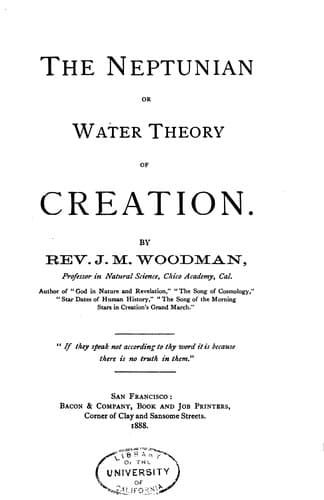
The Neptunian, or Water Theory of Creation — John Shaqi
The Neptunian, or Water Theory of CreationWoodman, J. M.
Religion
The Neptunian, or Water Theory of Creation
Woodman, J. M.
Bible and science; Creation; Religion and science
time Moses says, “The Lord God had not caused it to rain on the Earth.”
“The plant and the herb of the field had not yet been made.”
3. With such a pole-pointing, only one end of the Earth could receive
deposits, and the sun could take hold only of that end. Job alludes to a
convulsion in which “The proud were shaken out of it, that the sun might
take hold of both ends of it.” 38:13. Before this change, “The waters
were covered as with a stone, and the deep was frozen.” Deposits are now
made from the air at the rate of four hundredths of an inch in a year.
At this rate it would take, possibly, eighty million of years to reach
the surface. Our globe was never a rain-less planet.
4. The allusion to its not having rained on the earth, is an allusion
that the deposits were yet beneath the waters, until the “dry land
appeared.” Following the changes of organic life up to the time of the
deposits of the “Old Red Sand Stone,” where God spread out the waving
forests of the Devonian plain, he had found the fit contrast to the
inorganic deposit of the evening.
5. The climate of the first part of the third clay was chilled to the
temperature of melting ice. The latter part was torrid. The equator
marked the bound between perpetual sunlight and perpetual darkness.
Along this equator a line of open sea would beat against a line of
perpetual ice. The spray and vapor from the open sea, going south, would
be rapidly converted into snow and ice, increasing the thickness and
gravity of the ice. At length, breaking by its own weight, it would
drift into the open sea. During the first part of this day, there was
nothing to prevent this drift-ice finding its way to the very north
pole. The sea, therefore, would be at a temperature of 32 degrees Fahr.
6. After the deposits neared the top, and before dry land appeared, the
larger bergs were kept back, and tropical waters resulted, followed by
the same climate upon the dry land, as it appeared. At the close of this
day there existed many kinds of water animals, but they did not form a
suitable contrast with what Moses had to start with, as evening. These
were inorganic deposits from the air. The organic deposits of the
Devonian forests are the morning. “And the earth brought forth the tree,
yielding fruit, whose seed was in itself (cryptogams) after his kind.”
“And the evening and the morning were the third day.”
Section 4.
The Work of the Fourth Day.
Public-domain text, read in full here on John Shaqi.
Reviews
Reviews
No reviews yet
Be the first to share your thoughts on this work.
Join the Discussion
Join the discussion
Sign in to leave a comment or review.
Sign InorCreate an account