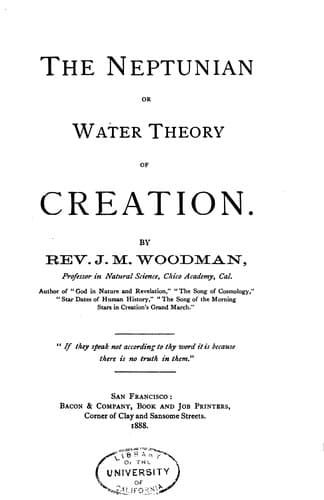
The Neptunian, or Water Theory of CreationWoodman, J. M.
Religion
The Neptunian, or Water Theory of Creation
Woodman, J. M.
Bible and science; Creation; Religion and science
1. The contrasts of evening and morning of the fifth day are found in
the sea. The contrasts of the sixth upon the land. The evening of the
fifth began with the “moving things of the sea,” ending with the
“whale.” With the exception of the first day, the fifth must have
extended through a much longer time than all the others put together.
The contrast between moving diatoms of the Gneiss rock, and the whale of
the Miocene in size, is apparent. But the contrast is in a higher sense.
All this long period to the Tertiary rock, gave only egg-producing
animals. This was not high enough in the scale of animal existence to
have the next evening, which must begin with the fifth morning, to form
a contrast with man. The type of the highest of mammals must be reached,
and that in the sea. This was found in the whale. Beside, the whale is
intimately connected with the great geological change caused by the
drift period. Here ninety-seven per cent of the previous animals of the
earth became extinct. Following the drift, there came into existence
nearly all the animals that now roam the Earth. This day, then, covers
all the changes of the fourth, and most of the third; and of course has
nothing to do with a measure of time, or order of deposits.
2. For aught we now know, the starting of animal life was in the time of
the deposit of the Gneiss rock—here we find shells. From here onward was
heard the voice of God, “Let the waters bring forth abundantly the
moving creature that hath life.” This life, at first, was very simple;
and small as simple. It required only the nourishment derived from water
for its support. No animals of any considerable size are found until
vegetables were furnished for their food. Those of the earlier period
had to be protected from the carbonated waters by a bony covering or
ivory scales. Scorpions, spiders, lizards and frogs might breathe the
carbonic acid of the fourth day; but no warm-blooded animals are known
to have existed until after the sun shone in upon the Earth, as a
fixture.
3. Here Moses noticed the existence of “fowls of the air.” In the
ichthyosaurus he might have found the contrast in size, but not in type.
4. He passed on down to the “whale as morning.” After the Carboniferous
deposits, the tracks of birds and reptiles are found in the ancient
sands of the shores of the waters. Gigantic saurians and voracious fish
ruled the sea for untold ages; but as they all were oviparous, or
egg-producing, they are ranked in the evening. Reaching the type of the
ruling land animals of the next day, Moses pronounced the morning with
the whale.
Public-domain text, read in full here on John Shaqi.
Reviews
Reviews
No reviews yet
Be the first to share your thoughts on this work.
Join the Discussion
Join the discussion
Sign in to leave a comment or review.
Sign InorCreate an account