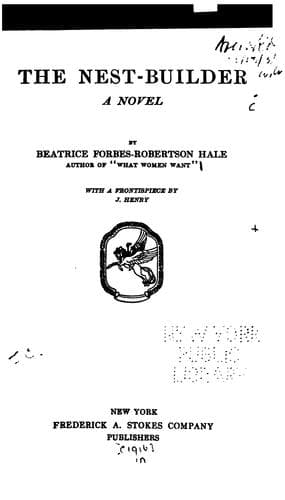
The Nest Builder: A NovelHale, Beatrice Forbes-Robertson
General
The Nest Builder: A Novel
Hale, Beatrice Forbes-Robertson
Marriage -- Fiction
New York was still strained and breathless from Saturday's horror. Men
sat idle in their offices reading edition after edition of the papers,
rage mounting in their hearts. Flags were at half mast. Little work was
being done anywhere save at the newspaper offices, which were keyed to
the highest pitch. Farraday's office was hushed. Those members of his
staff who were responsible for The Child at Home--largely women, all
picked for their knowledge of child life--were the worst demoralized.
How think of children's play-time stories when those little bodies were
being brought into Queenstown harbor? Farraday himself, the efficient,
the concentrated, sat absent-mindedly reading the papers, or drumming
a slow, ceaseless tap with his fingers upon the desk. The general gloom
was enhanced by their knowledge that Mac, their dear absurd Mac, was
going. But they were all proud of him.
By two o'clock Farraday had read all the news twice over, and Adolph's
letter three times.
Telephoning for his car to meet him, he left the office and caught an
early afternoon train home. He drove straight to the Byrdsnest and found
Mary alone in the sitting room.
She rose swiftly and pressed his hand:
“Oh, my dear friend,” she murmured, “isn't it terrible?”
He nodded. “Sit down, Mary, my dear girl.” He spoke very quietly,
unconsciously calling her by name for the first time. “I have something
to tell you.”
She turned white.
“No,” he said quickly, “he isn't dead.”
She sat down, trembling.
“I have a letter from Adolph Jensen. They are both wounded, and in the
American Hospital in Paris. The Foreign Legion has suffered heavily.
Jensen is convalescent, and returns to the front. He was beside your
husband in the trench. It was a shell. Byrd was hit in the back. My dear
child--” he stopped for a moment. “Mary--”
“Go on,” she whispered through stiff lips.
“He is paralyzed, my dear, from the hips down.”
She stared at him.
“Oh, no, James--oh, no, James--oh, no!” she whispered, over and over.
“Yes, my poor child. He is quite convalescent, and going about the wards
in a wheeled chair. But he will never be able to walk again.”
“Why,” said Mary, wonderingly, “he never used to be still--he always
ran, and skipped, like a child.” Her breast heaved. “He always ran,
James--” she began to cry--the tears rolled down her cheeks--she ran
quickly out of the room, sobbing.
James waited in silence, smoking a pipe, his face set in lines of
inexpressible sadness. In half an hour she returned. Her eyes were
swollen, but she was calm again.
“I'm sorry to have kept you waiting so long,” she said, with a pitiful
attempt at a smile. “Please read me the letter, will you?”
Public-domain text, read in full here on John Shaqi.
Reviews
Reviews
No reviews yet
Be the first to share your thoughts on this work.
Elsewhere in the archive
Join the Discussion
Join the discussion
Sign in to leave a comment or review.
Sign InorCreate an account