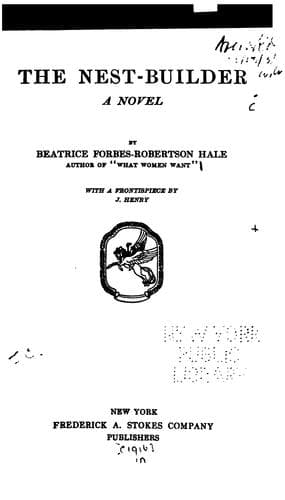
The Nest Builder: A NovelHale, Beatrice Forbes-Robertson
General
The Nest Builder: A Novel
Hale, Beatrice Forbes-Robertson
Marriage -- Fiction
Miss Berber vanished behind a portiere. The languid Marchmont draped
himself in a corner, and put the fat little meerschaum to his lips. A
clear, jocund sound, a mere thread of music, as from the pipe of some
hidden faun, penetrated the room. The notes trembled, paused, and fell
to the minor. Felicity, feet bare, toes touched with scarlet, wafted
into the room. Her dancing was incredibly light; she looked like
some exotic poppy swaying to an imperceptible breeze. The dance was
languorously sad, palely gay, a thing half asleep, veiled. It seemed
always about to break into fierce life, yet did not. The scent of
mandragora hung over it--it was as if the dancer, drugged, were dreaming
of the sunlight.
When, waving a negligent hand to the applause, Felicity passed Stefan at
the end of her dance, he caught a murmured phrase from her.
“Not soulless, perhaps, but sleeping.” Whether she meant this as an
explanation of her dance or of herself he was not sure.
Mary watched the dance with admiration, and wished to compare her
impressions of it with her husband's. She tried to catch his eye across
the room at the end, but he had drifted away toward the dining room.
Momentarily disappointed, she turned to find Farraday at her elbow, and
gladly let him lead her, also, in search of refreshments. There was
a general movement in that direction, and the drawing room was almost
empty as McEwan, purpose in his eye, strode across it to Constance. He
spoke to her in an undertone.
“Sing? Does she? I had no idea! She never tells one such things,” his
hostess replied. “Do you think she would? But she has no music. You
could play for her? How splendid, Mr. McEwan. How perfectly lovely
of you. I'll arrange it.” She hurried out, leaving McEwan smiling at
nothing in visible contentment. In a few minutes she returned with Mary.
“Of course I will if you wish it,” the latter was saying, “but I've no
music, and only know foolish little ballads.”
“Mr. McEwan says he can vamp them all, and it will be too delightful to
have something from each of my women stars,” Constance urged. “Now I'll
leave you two to arrange it, and in a few minutes I'll get every one
back from the dining room,” she nodded, slipping away again.
“Cruel man, you've given me away,” Mary smiled.
“I always brag about my friends,” grinned McEwan. They went over to the
piano.
“What price the Bard! Do you know this?” His fingers ran into the old
air for “Sigh No More, Ladies.” She nodded.
“Yes, I like that.”
“And for a second,” he spun round on his stool, “what do you say to a
duet?” His candid blue eyes twinkled at her.
“A duet!” she exclaimed in genuine surprise. “Do you sing, Mr. McEwan?”
“Once in a while,” and, soft pedal down, he played a few bars of
Marzials' “My True Love Hath My Heart,” humming the words in an easy
barytone.
“Oh, what fun!” exclaimed Mary. “I love that.” They tried it over, below
their breaths.
Public-domain text, read in full here on John Shaqi.
Reviews
Reviews
No reviews yet
Be the first to share your thoughts on this work.
Elsewhere in the archive
Join the Discussion
Join the discussion
Sign in to leave a comment or review.
Sign InorCreate an account