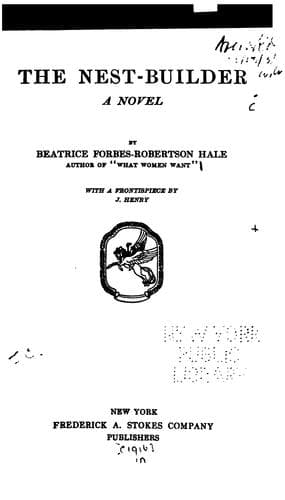
The Nest Builder: A NovelHale, Beatrice Forbes-Robertson
General
The Nest Builder: A Novel
Hale, Beatrice Forbes-Robertson
Marriage -- Fiction
“Yes, my dear,” went on the other, her beautiful little hands, which she
seldom gloved, playing with the inevitable string of jade, “the result
of modern specialization. Theodore is a darling, and in theory a
Suffragist, but he has practised the matrimonial division of labor so
long that he does not know what to do with the woman out of the home.”
“This is Queensborough Bridge,” she pointed out in a few minutes,
as they sped up a huge iron-braced incline. “It looks like eight
pepper-castors on a grid, surmounted by bayonets, but it is very
convenient.”
Mary laughed. Constance's flow of small talk always put her in good
spirits. She looked about her with interest as the car emerged from
the bridge into a strange waste land of automobile factories, new
stone-faced business buildings, and tumbledown wooden cottages. The
houses, in their disarray, lay as if cast like seeds from some titanic
hand, to fall, wither or sprout as they listed, regardless of plan. The
bridge seemed to divide a settled civilization from pioneer country, and
as they left the factories behind and emerged into fields dotted with
advertisements and wooden shacks Mary was reminded of stories she had
read of the far West, or of Australia. Stefan leant back from the front
seat, and waved at the view.
“Behold the tin can,” he cried, “emblem of American civilization!” She
saw that he was right; the fields on either side were dotted with tins,
bottles, and other husks of dinners past and gone. Gradually, however,
this stage was left behind: they began to pass through villages of
pleasant wooden houses painted white or cream, with green shutters,
or groups of red-tiled stucco dwellings surrounded by gardens in the
English manner. Soon these, too, were left, and real country appeared,
prettily wooded, in which low-roofed homesteads clung timidly to the
roadside as if in search of company.
“What dear little houses!” Mary exclaimed.
“Yes,” said Constance, “that is the Long Island farmhouse type, as good
architecturally as anything America has produced, but abandoned in favor
of Oriental bungalows, Italian palaces and French châteaux.”
“I should adore a little house like one of those.”
“Wait till you see Mr. Farraday's cottage; it's a lamb, and his home
like it, only bigger. What can one call an augmented lamb? I can only
think of sheep, which doesn't sound well.”
“I'm afraid we should say it was 'twee' in England,” Mary smiled, “which
sounds worse.”
“Yes, I'd rather my house were a sheep than a 'twee,' because I do at
least know that a sheep is useful, and I'm sure a 'twee' can't be.”
“It's not a noun, Constance, but an adjective, meaning sweet,”
translated Mary, laughing. She loved Constance's nonsense because it
was never more than that. Stefan's absurdities were always personal and,
often, not without a hidden sting.
Public-domain text, read in full here on John Shaqi.
Reviews
Reviews
No reviews yet
Be the first to share your thoughts on this work.
Elsewhere in the archive
Join the Discussion
Join the discussion
Sign in to leave a comment or review.
Sign InorCreate an account