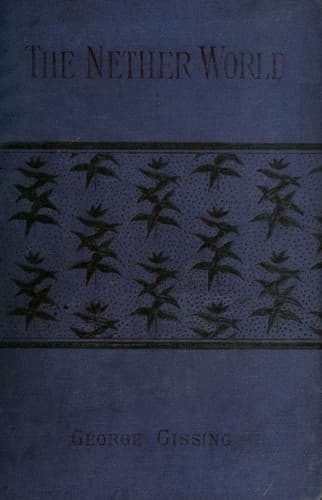
English fiction -- 19th century; London (England) -- Fiction; Poor -- Fiction; Poverty -- Fiction
Try to read her mind. The world had all at once grown very large, a
distress to her imagination; worse still, she had herself become a
person of magnified importance, irrecognisable in her own sight,
moving, thinking so unnaturally. Jane, I assure you, had thought very
little of herself hitherto—in both senses of the phrase. Joyous because
she could not help it, full of gratitude, admiration, generosity, she
occupied her thoughts very much with other people, but knew not
self-seeking, knew not self-esteem. The one thing affecting herself
over which she mused frequently was her suffering as a little thrall in
Clerkenwell Close, and the result was to make her very humble. She had
been an ill-used, ragged, work-worn child, and something of that
degradation seemed, in her feeling, still to cling to her. Could she
have known Bob Hewett’s view of her position, she would have felt its
injustice, but at the same time would have bowed her head. And in this
spirit had she looked up to Sidney Kirkwood, regarding him as when she
was a child, save for that subtle modification which began on the day
when she brought news of Clara Hewett’s disappearance. Perfect in
kindness, Sidney had never addressed a word to her which implied more
than friendship—never until that evening at the farm; then for the
first time had he struck a new note. His words seemed spoken with the
express purpose of altering his and her relations to each other. So
much Jane had felt, and his change since then was all the more painful
to her, all the more confusing. Now that of a sudden she had to regard
herself in an entirely new way, the dearest interest of her life
necessarily entered upon another phase. Struggling to understand how
her grandfather could think her worthy of such high trust, she
inevitably searched her mind for testimony as to the account in which
Sidney held her. A fearful hope had already flushed her cheeks before
Michael spoke the words which surely could have but one meaning.
On one point Sidney had left her no doubts; that his love for Clara
Hewett was a thing of the past he had told her distinctly. And why did
he wish her to be assured of that? Oh, had her grandfather been
mistaken in those words he reported? Durst she put faith in them,
coming thus to her by another’s voice?
Public-domain text, read in full here on John Shaqi.
Reviews
Reviews
No reviews yet
Be the first to share your thoughts on this work.
Elsewhere in the archive
Join the Discussion
Join the discussion
Sign in to leave a comment or review.
Sign InorCreate an account