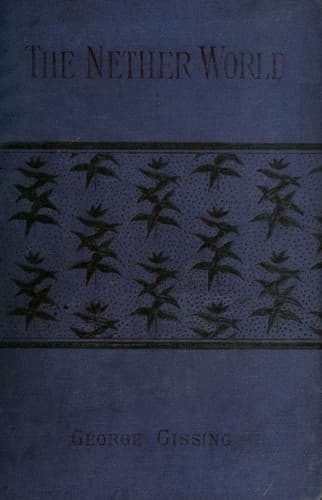
English fiction -- 19th century; London (England) -- Fiction; Poor -- Fiction; Poverty -- Fiction
Ever since the disclosure made to him by Michael Snowdon at Danbury he
had been sensible of a grave uneasiness respecting his relations with
Jane. At the moment he might imagine himself to share the old man’s
enthusiasm, or dream, or craze—whichever name were the most
appropriate—but not an hour had passed before he began to lament that
such a romance as this should envelop the life which had so linked
itself with his own. Immediately there arose in him a struggle between
the idealist tendency, of which he had his share, and stubborn everyday
sense, supported by his knowledge of the world and of his own being—a
struggle to continue for months, thwarting the natural current of his
life, racking his intellect, embittering his heart’s truest emotions.
Conscious of mystery in Snowdon’s affairs, he had never dreamed of such
a solution as this; the probability was—so he had thought—that Michael
received an annuity under the will of his son who died in Australia. No
word of the old man’s had ever hinted at wealth in his possession; the
complaints he frequently made of the ill use to which wealthy people
put their means seemed to imply a regret that he, with his purer
purposes, had no power of doing anything. There was no explaining the
manner of Jane’s bringing-up if it were not necessary that she should
be able to support herself; the idea on which Michael acted was not
such as would suggest itself, even to Sidney’s mind. Deliberately to
withhold education from a girl who was to inherit any property worth
speaking of would be acting with such boldness of originality that
Sidney could not seriously have attributed it to his friend. In fact,
he did not know Michael until the revelation was made; the depths of
the man’s character escaped him.
The struggle went all against idealism. It was a noble vision, that of
Michael’s, but too certainly Jane Snowdon was not the person to make it
a reality; the fearful danger was, that all the possibilities of her
life might be sacrificed to a vain conscientiousness. Her character was
full of purity and sweetness and self-forgetful warmth, but it had not
the strength necessary for the carrying out of a purpose beset with
difficulties and perils. Michael, it was true, appeared to be aware of
this; it did not, however, gravely disturb him, and for the simple
reason that not to Jane alone did he look for the completion of his
design; destiny had brought him aid such as he could never have
anticipated; Jane’s helpmate was at hand, in whom his trust was
unbounded.
Public-domain text, read in full here on John Shaqi.
Reviews
Reviews
No reviews yet
Be the first to share your thoughts on this work.
Elsewhere in the archive
Join the Discussion
Join the discussion
Sign in to leave a comment or review.
Sign InorCreate an account