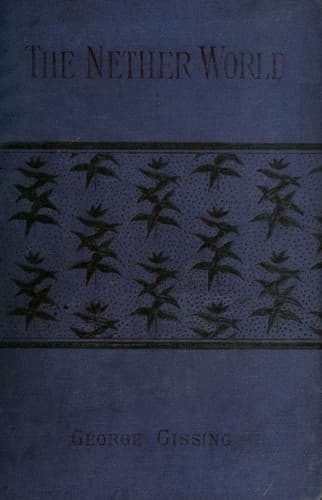
English fiction -- 19th century; London (England) -- Fiction; Poor -- Fiction; Poverty -- Fiction
In these few hours she so wrought upon her imagination as to believe
that the one love of her life had declared itself. She revived every
memory she possibly could of those years on the far side of the gulf,
and convinced herself that even then she had loved Sidney. Other love
of a certainty she had not known. In standing face to face with him
after so long an interval, she recognised the qualities which used to
impress her, and appraised them as formerly she could not. His features
had gained in attractiveness; the refinement which made them an index
to his character was more noticeable at the first glance, or perhaps
she was better able to distinguish it. The slight bluntness in his
manner reminded her of the moral force which she had known only as
something to be resisted; it was now one of the influences that drew
her to him. Had she not always admitted that he stood far above the
other men of his class whom she used to know? Between his mind and hers
there was distinct kinship; the sense that he had both power and right
to judge her explained in a great measure her attitude of defiance
towards him when she was determined to break away from her humble
conditions. All along, had not one of her main incentives to work and
strive been the resolve to justify herself in _his_ view, to prove to
_him_ that she possessed talent, to show herself to _him_ as one whom
the world admired? The repugnance with which she thought of meeting
him, when she came home with her father, meant in truth that she
dreaded to be assured that he could only shrink from her.
All her vital force-setting in this wild current, her self-deception
complete, she experienced the humility of supreme egoism—that state
wherein self multiplies its claims to pity in passionate support of its
demand for the object of desire. She felt capable of throwing herself
at Sidney’s feet, and imploring him not to withdraw from her the love
of which he had given her so many assurances. She gazed at her scarred
face until the image was blurred with tears; then, as though there were
luxury in weeping, sobbed for an hour, crouching down in a corner of
her room. Even though his love were as dead as her beauty, must he not
be struck to the heart with compassion, realising her woeful lot? She
asked nothing more eagerly than to humiliate herself before him, to
confess that her pride was broken. Not a charge he could bring against
her but Bile would admit its truth. Had she been humble enough last
night? When he came again—and he must soon—she would throw aside every
vestige of dignity, lest he should think that she was strong enough to
bear her misery alone. No matter how poor-spirited she seemed, if only
she could move his sympathies.
Public-domain text, read in full here on John Shaqi.
Reviews
Reviews
No reviews yet
Be the first to share your thoughts on this work.
Elsewhere in the archive
Join the Discussion
Join the discussion
Sign in to leave a comment or review.
Sign InorCreate an account