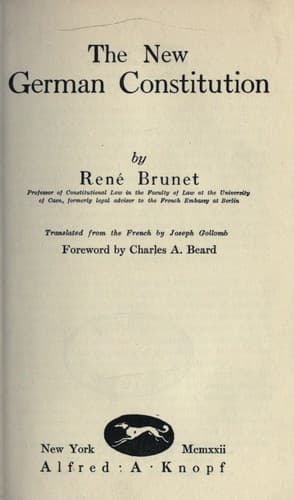
Germany -- Politics and government -- 1918-1933; Germany. Verfassung (1919)
Generally the number of Ministers is variable. Instead of having a
fixed number of departments corresponding to a rational distribution of
affairs, there are created or abolished Ministries according to the needs
that have to be met to satisfy the demands of this or that political
group. The Scheidemann Ministry had a Minister of Finance. But the Bauer,
Hermann Müller, and the Fehrenbach Ministries had, in addition to a
Minister of Finance, also a Minister of the Treasury. On the other hand,
there was in the Scheidemann Cabinet a Minister of Economy, Wissel, and a
Minister of Food Supply, Robert Schmidt. These two Ministers kept their
portfolios in Bauer’s Cabinet formed in June, 1919. Then dissensions
arising between Wissel and the other members of the Cabinet, Wissel
resigned. But he was not replaced and the two Cabinet posts were made
one. They were again made two, however, and provided with distinct titles
in the Cabinets of Hermann Müller and Fehrenbach. A similar situation
exists in the case of Ministers without portfolio, whose number, when
there are any, is variable.
Sometimes in spite of all possible negotiations and combinations the
various groups necessary for a coalition commanding a majority cannot
arrive at an agreement. As a government must nevertheless be finally
constituted, this or that group, which has refused to enter into the
combination, promises nevertheless either its support or its neutrality
to those who have had the imprudence to participate in the Cabinet. When
the Fehrenbach Cabinet was constituted it could only count on the vote
of the groups represented in it and, therefore, commanded only 200 votes
in an Assembly of 466 members. But the Social Democrats promised not
to overthrow the Ministry until the new elections. The consequence of
this is that a Cabinet so placed is really not its own master, and this
one had to yield to a certain degree to the injunctions of the Social
Democrats. But on the other hand the latter, although they had refused to
enter the combination, were indirectly responsible for the acts of the
Ministry so long as they tolerated them in power.
When the necessary agreements are concluded, the Ministry appears
before the Reichstag. It reads its declaration and programme and a
grand political discussion commences. But the programme having been in
advance submitted to the groups, sometimes even corrected and redrawn
at inter-group meetings, the Ministry is sure of a majority and the
discourses are only manifestos by which each party explains why it is for
or against the Ministry.
* * * * *
Public-domain text, read in full here on John Shaqi.
Reviews
Reviews
No reviews yet
Be the first to share your thoughts on this work.
Elsewhere in the archive
Join the Discussion
Join the discussion
Sign in to leave a comment or review.
Sign InorCreate an account