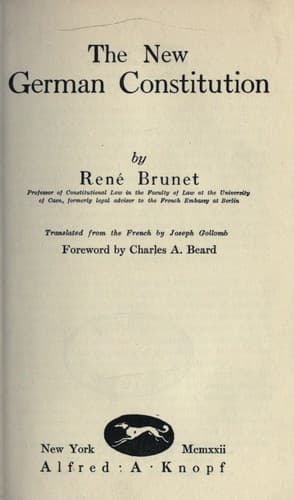
Germany -- Politics and government -- 1918-1933; Germany. Verfassung (1919)
interpretation, it would appear that these articles, from the point of
view of their legal efficacy, may be divided into three categories.
(1) Those having the force of law. These create actually and immediately
some new law, and consequently abrogate contradictory provisions of
antecedent laws. Such, for example, is Article 109, par. 6: “No German
may accept a title or order from a foreign Government.”
(2) Others limit themselves to _indicating_ to legislators of the Reich
and of the States the _course which they must in the future follow_
and prescribe the laws they must enact. But these provisions do not in
themselves constitute laws, and, therefore, cannot abrogate _ipso facto_,
contradictory provisions in antecedent laws. Such is the principle in
Article 145, according to which “Instruction and school supplies … are
free.” This cannot have for its effect the immediate doing away with
payments by pupils in the schools for supplies furnished them. There
is no doubt that the principle of gratuity cannot enter into operation
except through a special law expressly prescribed.
(3) Other provisions express _general truths_, which are most often
_ordinary philosophico-legal commonplaces_, whose exact meaning and
bearing in a text such as the Constitution is difficult to grasp. For
example, it is hard to see the special significance which a phrase can
have in a constitutional document such as the one which declares that
marriage is placed under the special protection of the Constitution.
* * * * *
However diverse may be the conceptions that prevailed at the drawing up
of the fundamental rights, and whatever uncertainty they may present from
the legal point of view, it is possible, nevertheless, when the whole of
the second part of the Constitution of Weimar is surveyed, to discover in
these articles some common characteristics and to unfold the fundamental
ideas that have inspired the majority of the Constituent Assembly.
It is evident that the Assembly conceived the fundamental rights and
duties in a manner quite different from that of the authors of preceding
Declarations of Rights in America, France, or even in Germany. These
declarations were inspired by purely individualistic doctrine. Man is by
nature free and independent; he holds rights that are limited only by
such other rights as will assure to other men the enjoyment of the same
rights as his. From this ensues a twofold consequence. First, he may act
in his own right provided that he confines himself within the limits of
the right in question. Within these rights he is truly sovereign, and the
state may not encroach on them to impose any obligation whatsoever. On
the other hand, conversely, the state does not owe any positive service
or pledge to the profit of the individual. It must abstain from all
interference and allow him free individual activities. The State owes
nothing to the individual, who in turn can claim nothing from it.
Public-domain text, read in full here on John Shaqi.
Reviews
Reviews
No reviews yet
Be the first to share your thoughts on this work.
Elsewhere in the archive
Join the Discussion
Join the discussion
Sign in to leave a comment or review.
Sign InorCreate an account