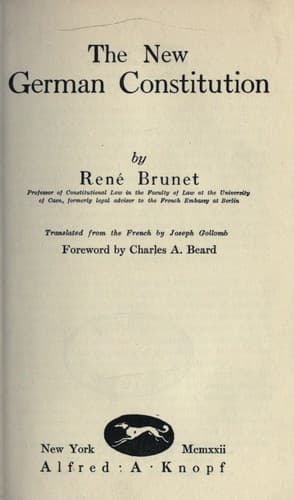
Germany -- Politics and government -- 1918-1933; Germany. Verfassung (1919)
68 representatives of agriculture and forestry.
6 representatives of market industries and fisheries.
68 representatives of general industry.
44 representatives of commerce, banks and insurance.
34 representatives of transport enterprises.
36 representatives of small business and small industries.
30 representatives of consumers (municipalities, consumers’
associations and organizations of women).
16 representatives of civil servants and the professions.
24 other persons named by the government.
II.--There then followed the question of how the delegates of each
group are to be appointed. The discussion reverted to the question
whether these delegates should be appointed by vocation or region.
Where employers and workers were grouped, the principle of parity was
naturally adhered to. Agriculture, for example, which is entitled to 44
delegates, was represented by 22 land owners and 22 agricultural workers.
On the other hand, the mode of nomination in all groups representing
workers offered but few problems, for--at least until the Factory Workers
Councils have united and become organized geographically over the whole
Reich--the only labour organizations are those of the Trade Unions;
that is to say, organizations almost exclusively vocational, and the
labour delegates to the Economic Council cannot be elected except by
means of these organizations. But the problem became much more complex
in the case of the election of representatives of employers and property
owners. These had, in addition to their industrial associations, organs
of regional representation, such as chambers of commerce, chambers of
agriculture, boards of trade, etc. Should their delegates throughout be
elected by regional organs or by associations? The Reichsrat replied, by
chambers of commerce; and the National Assembly declared for associations.
The partisans of representation by chambers of commerce pointed out
that these chambers are, according to existing legislation, the only
representatives of industry and of commerce in public law; that
they embrace all the industrial and commercial circles, considered
vocationally as well as regionally, and that they constitute an electoral
body more complete than the organizations on a purely professional basis;
and that, in contrast to the associations, the chambers of commerce are
elected by all the manufacturers and merchants inscribed on the register
of commerce.
Public-domain text, read in full here on John Shaqi.
Reviews
Reviews
No reviews yet
Be the first to share your thoughts on this work.
Elsewhere in the archive
Join the Discussion
Join the discussion
Sign in to leave a comment or review.
Sign InorCreate an account