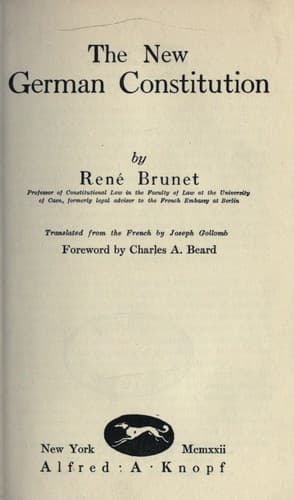
Germany -- Politics and government -- 1918-1933; Germany. Verfassung (1919)
But to-day ideas on the rôle of the state are changing. The state in
the last few decades has little by little ceased to limit its activity
to the rôle of “watcher of the night,” which liberalism assigned to it;
and more and more the organs of the state have been forced to exercise
an influence on public economy. Modern parliamentarism is insufficient
to permit the state to fill its new duties. For the political chambers
are divided in parties that group themselves according to changeable
ideological conceptions, based on the idea of “what should be,” the idea
that dominates the parties. But in taking a position in accordance with
such articles of faith and political axioms, one does not acquire the
necessary technical knowledge to gauge and judge economic questions. In
this matter there is only one method of learning, that is to study the
facts of economic life. What follows from this is self-evident. We must,
if not actually suppress the political parliament, at least put beside it
special organs charged with fulfilling the economic duties of the state.
(See August Müller, _Socialisierung oder Socialismus?_ Berlin, 1919.)
And these organs can be nothing but Councils, Workers Councils, Councils
of Producers.
Let us not cry immediately, Bolshevism! It is true that the system
of Workers Councils was born in Russia. First appearing under the
Revolution of 1905, we see them reappear in 1917, but it was not the
Bolsheviks who brought them into being. The Soviets were born because in
pre-revolutionary Russia the law did not tolerate unions of workers. As
a consequence the only form that an organization could take to combat
the tyranny of the Czars was to nominate in every factory, shop, etc.,
men who could be trusted. In 1917, Russian Workers Councils formed the
strongest support of the democracy; they were the firmest adherents of
the government formed by Kerensky. But when the Bolsheviks seized power
they crushed the democratic Soviets in the sense that they would not
any longer permit them to elect their members to office, and they, the
Bolsheviks, nominated men to represent these unions. In this fashion they
erected their dictatorship, a dictatorship of a small group, with the
slogan of, “All power to the Workers Councils!” But the advent of Workers
Councils has nothing in common with Bolshevism.[19]
To political representation one must join economic representation,
constituted essentially by the Councils. Workers Councils, somewhat
like those which Däumig would organize, are retained; to them should be
assigned the representation of workers’ rights, which have hitherto been
defended by the unions.
Public-domain text, read in full here on John Shaqi.
Reviews
Reviews
No reviews yet
Be the first to share your thoughts on this work.
Join the Discussion
Join the discussion
Sign in to leave a comment or review.
Sign InorCreate an account