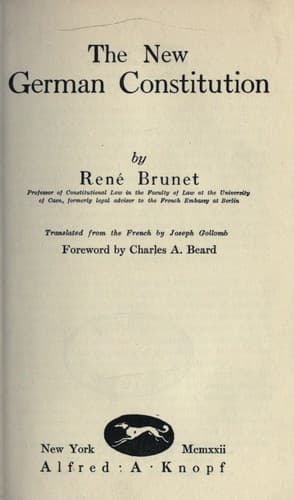
Germany -- Politics and government -- 1918-1933; Germany. Verfassung (1919)
But by their side should be created Councils of Production
(Produktionsräte) charged, as their name indicates, with supervision of
production. There will be organized in each locality and for each branch
of economic activity a Council of Production. The enterprises of the
locality will each be represented by an equal number of delegates of the
employers and delegates of employés, for _the principle of parity between
employers and employés is absolute_. Above the Councils of Productions
of the communes there will be superimposed for each branch Councils of
Groups, Councils of the Province, etc., culminating in Central Council of
Production (Zentralproduktionsrat). There is thus for the whole territory
of the Reich a Central Council of Metallurgical Production, a Central
Council of Breweries, a Central Council of Chemical Production, etc.
There is in addition at each stage of the above structure a corresponding
economic council or Chamber of Labour, formed by a meeting of the
delegates of the Councils of Production of that stage.
The union of the delegates of the Councils of Production of each stage
constitutes a Chamber of Labour, that is to say, by the side of the
political assembly of the commune, of the district, of the province,
as well as by the side of the National Assembly, there is room for a
communal Chamber of Labour, a Chamber of Labour of the district, a
Chamber of Labour of the Province, and a National Chamber of Labour,
where all the economic interests of the commune, the district, the
province, and of the Reich, are represented. By means of a Chamber of
Commerce, the producers, as producers, participate in political life.
It is an economic parliament by the side of a political parliament.
Whether in the commune, the province, or the Reich, no assembly elected
according to merely habitual democratic principles (Volkskammer) can
of itself deliver verdicts or decisions of principle. An ordinance of
a communal assembly would have to be submitted to the approval of the
corresponding Chamber of Labour just as a law passed by the National
Assembly would have to be ratified by the National Chamber of Labour, no
matter what its subject matter. The Chamber of Labour thus plays the rôle
of a second chamber and its veto cannot be broken unless for three years
in succession the popular chambers vote the same provisions in the same
terms in regard to the matter in conflict. The Chamber of Labour and the
popular chamber have equally the right to invoke a referendum. Finally,
it belongs in principle to the Chamber of Labour to be the first to
examine all projects of an economic character; and it can, when it sees
fit, take the initiative in proposing a law.
Public-domain text, read in full here on John Shaqi.
Reviews
Reviews
No reviews yet
Be the first to share your thoughts on this work.
Join the Discussion
Join the discussion
Sign in to leave a comment or review.
Sign InorCreate an account