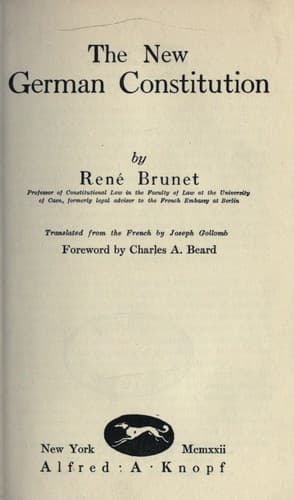
Germany -- Politics and government -- 1918-1933; Germany. Verfassung (1919)
The champions of the Chamber of Labour, continue the democrats, are
guilty of a fundamental error. They believe that in economic questions
there are only such problems as can be studied by the technicians,
and that these can give such problems the only and obvious solutions.
Actually, however, even in purely economic questions, we ask always not
what is, but what should be, what we want of them and what we can effect.
A technical knowledge of circumstances, of causes, and consequences is
naturally necessary for a serious decision. But, even after the most
scientific examination, one arrives almost always, and above all in
important questions, at diverse conclusions, only because different aims
have been followed. _These conclusions are always dictated by political
conceptions._ Technicians can decide the best system for cleaning the
streets; though even here it may be a political question to know if such
a system, which is the best but also the most costly, can or should be
employed. But when it comes to questions of Sunday rest, if woman labour
should be countenanced, if and how the land should be distributed, how
the relations between capital and labour should be organized in the great
modern enterprises, and perhaps above all, who should pay the taxes--all
these questions and an infinity of others raise up problems not of
knowledge but of will. They are the questions in which the concern is not
with economy but with the situation of man, his rights, his liberty, and
his dignity within the economy. It is a question of the power of deciding
for the collectivity on a subject of collective interests. It is not for
the technician to decide, but for the man political.
Public-domain text, read in full here on John Shaqi.
Reviews
Reviews
No reviews yet
Be the first to share your thoughts on this work.
Elsewhere in the archive
Join the Discussion
Join the discussion
Sign in to leave a comment or review.
Sign InorCreate an account