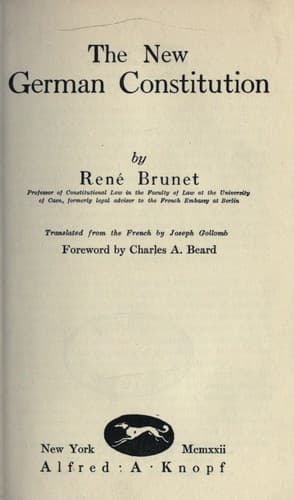
Germany -- Politics and government -- 1918-1933; Germany. Verfassung (1919)
A last and decisive objection, conclude the democrats, against the
system of a vocational parliament is that it replaces or annihilates
the democratic Chamber elected by the equal suffrage of all, that is
to say, by democracy itself, and substitutes for it a professional
chamber elected by a plural vote of privileged persons. Let the proposal
be remembered which the Prussian conservatives submitted two months
before the Revolution of 1918 to effect, as they claimed, the equality
of the right to suffrage. Each elector was to have one vote within his
professional vocational group; but the representation contemplated by
this proposition was that the group of farmers were to have one seat
for every 12,295 electors, whereas their labourers would not get more
than one seat for every 110,530, a landed proprietor having electoral
power ten times as strong as that of an agricultural labourer, six
times as strong as that of a factory worker and one-and-a-half times
as strong as that of a civil servant. It is true that the division of
mandates in a Chamber of Labour would not result in as anti-democratic
consequences as these; but the project of this chamber is based on the
essential principle of parity between employers and workers; the two are
supposed to be rigorously equal in numbers. That would be self-evident
and understandable fully if the two groups had to settle questions in
which their reciprocal interests were opposed, or if it were a question
purely technical, where the number of delegates does not enter into
consideration. But it is absolutely impossible to admit that an assembly
thus constituted should take decisions or vote resolutions; for, _a
numerically equal representation both of employers and employés would
correspond obviously to a proportion of electors much greater for one
class than for the other_. In any industry, for example, an employer
represents considerably fewer electors than a worker, and to give his
voice in the direction of public affairs an influence equal to that of a
worker, would be, from the point of view of democracy, an absurdity. One
thing or the other. Either the seats in the Vocational Parliament are
apportioned among the professions according to the number of electors in
each, the representatives being elected in each vocation by the equal
suffrage of all without distinction between employer and employé--in
which case there would result a duplication of the political parliament
of which the least one can say is that there is no apparent utility
in it. Or, the number of seats attributed to each profession must be
measured by the economic or social importance of that profession, basing
representation in each profession on the principle of parity--in which
case there would result a parliament of the privileged, condemned by
the democratic ideal. An assembly thus composed could very well draw
up reports and give advice on questions in which it possesses special
competence.
Public-domain text, read in full here on John Shaqi.
Reviews
Reviews
No reviews yet
Be the first to share your thoughts on this work.
Elsewhere in the archive
Join the Discussion
Join the discussion
Sign in to leave a comment or review.
Sign InorCreate an account