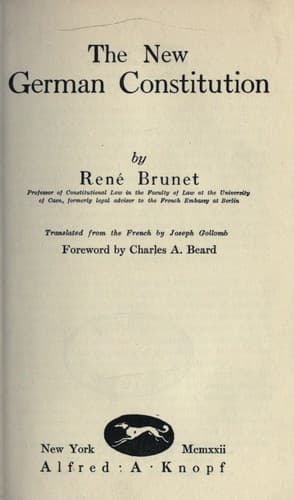
Germany -- Politics and government -- 1918-1933; Germany. Verfassung (1919)
These statements are undoubtedly exaggerations in two respects. One fact
meanwhile must be noted of importance here. While the government was
discussing with the unions the formation of the ministry the newspapers
printed vehement protests from vocational associations and from other
labour unions and groups of clerks and civil servants, which demanded
that they, too, be allowed to participate in the negotiations. For they
did not understand why the labour unions should alone have the privilege
of participating, for example, in the choice of Ministers--and it is
impossible from the democratic point of view to deny the force of their
position.
Without deducing from these facts any premature conclusions one may ask
if the supporters of an Economic Parliament are not right in saying
that formal democracy no longer is able to meet the actual needs of the
people.
The events of the months, March-April, 1920, demonstrated, they say,
the complete incapacity of political powers to surmount any difficulty
as soon as it becomes in the least serious. One of them wrote, “The
political party is about to become a superfluous organization; it is
being ousted or perhaps absorbed by the vocational association.”[25] A
new epoch demands new political forms. It is true that it is inadmissible
for a certain class of unions to arrogate to itself the right to impose
its wishes on a government of the whole people. We must not think, on
the other hand, that in the future the unions would renounce the use of
means which have hitherto proved to be powerful. There is only one remedy
open: to associate the other productive parties of the nation with the
political work of the unions; to transform this present irregular and
irresponsible political work, such as it is now, into a constitutional
collaboration with the government of the state. It is there that the
events of the month of March have demonstrated the necessity of changing
the present system. These events appear thereby one of the steps which
lead from a formal democracy to a real democracy, from a purely political
parliamentarism of the past to a politico-economic parliamentarism of the
future.
SECTION II
APPLICATIONS
The democratic principle is one of the bases on which the Constitution
of August 11 is constructed; more or less immediate applications of it
are found in most of the institutions provided for by this Constitution.
We shall confine ourselves here to the study of the principal and most
direct of these applications.
1.--THE REPUBLIC.
Public-domain text, read in full here on John Shaqi.
Reviews
Reviews
No reviews yet
Be the first to share your thoughts on this work.
Elsewhere in the archive
Join the Discussion
Join the discussion
Sign in to leave a comment or review.
Sign InorCreate an account