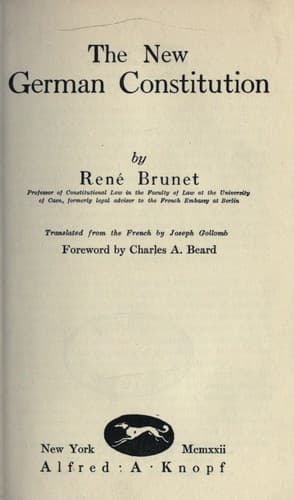
Germany -- Politics and government -- 1918-1933; Germany. Verfassung (1919)
The normal form of a government in a democracy is the republic. It is
logical that if the people is sovereign and if all power comes from the
people the chief of the state, like its other organs, should be elected
by the people and hold his authority by virtue of it. It is true that
there may be and that there are democratic monarchies, such as, for
example, England. But this juxtaposition of monarchy and democracy, is,
from the point of view of theory, difficult to justify and in practice
can be maintained only by reducing the effective power of the monarch
to almost nothing. Democratic Germany therefore, must be republican. In
reality the National Assembly arrived at a republic much less by logical
compulsion than through actual necessity; like the French Assembly of
1875, it adopted the republican form because it was difficult for it,
if not impossible, to do otherwise. It seems that the great modern
democracies do not become republican until monarchy has been demonstrated
as impossible. The republic is at the outset only a last resort; and this
must be realized and borne in mind.
Before the Revolution nothing in Germany was republican. Almost totally
deprived of political spirit and personal judgment the German people
had let themselves be convinced that it was only in the hands of the
monarchy, the army, and the bureaucracy that the affairs of the nation
were best and most safely conducted; and they naturally came to think
that the prosperity in Germany in economic and in technical matters,
as well as its development in social matters, was undeniable proof of
the excellence of the monarchical system. No political party dreamed of
incorporating in its program the establishment of a republic. Not even
the Social Democrats themselves really believed that the republican form
was a thing which the time had come to demand. They even held that the
economic and social interests of the working class could be more solidly
assured by a powerful monarchy than by a republic and a democracy of
“capitalists.”
After the Revolution the situation changed entirely. The sudden and
complete bankruptcy of monarchy demonstrated overnight, with all the
convincing force of fact, that this monarchy, in spite of its apparent
force, was incapable of fulfilling the duties whose accomplishment alone
could justify its existence. The powerful monarchy had not had any clear
and co-ordinated foreign policy; it had turned against Germany all the
active forces of the world; it had shown itself unable to utilize to its
full limit the military and economic capacity of the German people for
waging a desperate war to an acceptable conclusion; it had not been able
to realize indispensable internal reforms. After November 9, one can say
that there were no more royalists in Germany; monarchy had become really
impossible and the Reich could not continue except as a republic.[26]
Public-domain text, read in full here on John Shaqi.
Reviews
Reviews
No reviews yet
Be the first to share your thoughts on this work.
Elsewhere in the archive
Join the Discussion
Join the discussion
Sign in to leave a comment or review.
Sign InorCreate an account