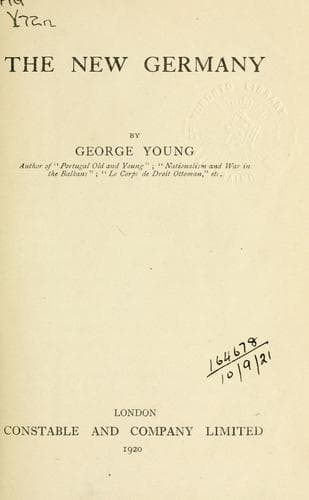
Germany -- History -- Revolution, 1918; Germany -- Politics and government -- 1918-1933
When we come to the all-important region of education, the conditions
of compromise in which the Constitution took shape have prevented the
establishment of any very clear principle or very cut and dried
procedure. This was indeed one of the most contentious chapters of
which 'clericalism' contested every inch. The Democrats and Dr. Preuss
had originally introduced a uniform and secular system; but they and
the Social-Democrats, in the abstention of the Independents, were
unable to carry this through against the Clerical Centrum. The
resultant compromise is not unlike that now prevailing in England. It
may work but it satisfies nobody.
And finally coming to the army the effect of the success secured by
the centralising party is even more questionable. The Revolution
originally contemplated merely a militia on the Swiss model, under
Federal control. The first result of reaction was to substitute a
professional and highly paid force, the Frei-Corps, under Prussian
command and control. The consequence of this was that the Southern
States insisted on retaining their separate military systems, and
these were duly recognised in the early drafts of the Constitution, to
the great disgust of nationalists and militarists. But then came the
proclamation of Räte-Republics in Saxony and Bavaria, and their
suppression by Prussian Frei-Corps with some assistance from
Würtemberg and Baden. This re-established, _de facto_, a military
predominance of Prussia which enabled the Prussian jurists to replace
military matters under the Federal Government. Art. 79 now gives
complete authority to the Minister of Defence; and the special
military autonomies of Bavaria and other States, reserved in previous
drafts, disappear. But, so long as the Frei-Corps continue, with their
Prussian organisation and officers, a Federal army is, for the
present, at least, nothing else than a Prussian army. Though Noske is
the Minister of Defence, not Minister of War, as he is sometimes
called, and is a member of a Federal Cabinet and not, as before, a
Prussian Minister, and though the Eden Hotel clique has been
transferred to the Ministry of Defence--yet the armed forces of the
Republic are, for the present, the armed forces of Prussia.
This is, however, a transition stage. The Prussian officer is the
creation of conditions that no longer exist to-day, and the Frei-Corps
a creation of conditions that will not exist to-morrow. When Germany
again gets peace, Prussia will lose a predominance that it owes to
past conditions, but not to the Constitution.
Public-domain text, read in full here on John Shaqi.
Reviews
Reviews
No reviews yet
Be the first to share your thoughts on this work.
Elsewhere in the archive
Join the Discussion
Join the discussion
Sign in to leave a comment or review.
Sign InorCreate an account