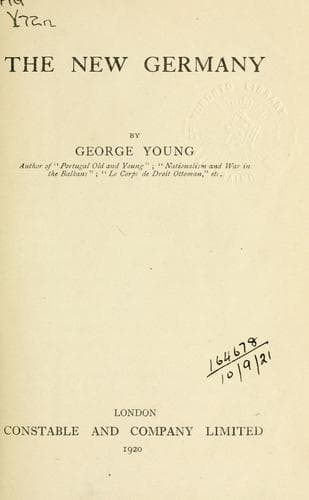
Germany -- History -- Revolution, 1918; Germany -- Politics and government -- 1918-1933
The deputies shall be elected by universal, equal, direct, and secret
suffrage by those of either sex over twenty years of age, on the
principles of proportional representation. The day of the election
must be a Sunday or public holiday. An electoral law of the Realm
shall lay down further detailed regulations.
ARTICLE 23.
The Reichstag shall be elected for four years. New elections must take
place at latest within sixty days after the expiration of its term of
office. The Reichstag must hold its first meeting at latest on the
thirtieth day after election.
ARTICLE 24.
The Reichstag shall meet on the first Wednesday of November in every
year at the seat of the Government. The President of the Reichstag is
bound to call it together at an earlier date if the President of the
Realm, or at least one-third of the deputies, demand it.
The Reichstag determines the date of the close of its session and the
date of its reassembly.
ARTICLE 25.[20]
The President of the Realm has power to dissolve the Reichstag, but
may only do so once on the same ground.
New elections must be held at latest on the sixtieth day after the
dissolution.
ARTICLE 26.
The Reichstag shall choose its own President, Vice-President, and
Secretaries. It shall regulate its own procedure.
ARTICLE 27.
The business of the House between two sessions or between two election
periods shall be conducted by the President of the Reichstag and the
Vice-President holding office during the preceding session.
ARTICLE 28.
Disciplinary and police powers within the Reichstag building pertain
to the President of the Reichstag. He also has the administration of
the House. He has control of the income and expenditure of the House
within the limits laid down by the national budget, and he represents
the House in all the legal proceedings and legal business involved in
its administration.
ARTICLE 29.
The sittings of the Reichstag are public. The public may be excluded
on the demand of fifty deputies and by a two-thirds majority vote.
ARTICLE 30.
True reports of the proceedings at the public sittings of the
Reichstag, of the proceedings at a Landtag, of the proceedings at
Committees of the Reichstag or Landtag, are privileged matter.
ARTICLE 31.
A Court of Inquiry into election proceedings shall be formed in
connection with the Reichstag. Such Court shall also decide whether
any deputy has forfeited his mandate.
The Court of Inquiry into election proceedings shall be formed of
members of the Reichstag, who shall be elected by the Reichstag for
the duration of the electoral period, and further of members of the
Supreme Administrative Court, who shall be nominated by the President
of the Realm on the suggestion of the Presiding officers of this
Court.
The Court of Inquiry into election proceedings shall pronounce
judgment in public and oral session through three members of the
Reichstag, and two legal members.
Public-domain text, read in full here on John Shaqi.
Reviews
Reviews
No reviews yet
Be the first to share your thoughts on this work.
Elsewhere in the archive
Join the Discussion
Join the discussion
Sign in to leave a comment or review.
Sign InorCreate an account