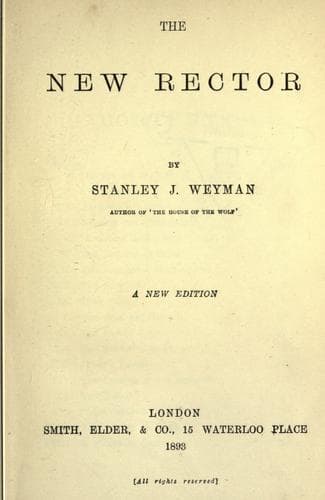
Clergy -- England -- Fiction; England -- Social life and customs -- 19th century -- Fiction
The ex-valet would have demurred to being thus set aside, but the earl
roaring “Go, you scoundrel!” in a voice he had been accustomed to obey,
and Mr. Bonamy opening the door for him, he submitted and went. The
streets were wet and gloomy, and he was more sober than he had been for
a week. In other words, his nerves were shaky, and he soon began, as he
slunk homeward, to torment himself with doubts. Had he made the best of
his story? Might it not have been safer to make a last appeal to the
rector? Above all, would Mr. Clode, whose game he did not understand,
hold his hand, or play the trump by disclosing that little burglary we
know of? Altogether Felton was not happy, and saw before him but one
resource—to get home as quickly as possible and get drunk.
Meanwhile the lawyer, left alone with his client, seemed as much averse
as before to speaking out. Lord Dynmore had again to take the
initiative. “Well, it is good enough, sir, is it not?” he said,
frowning impatiently on his new adviser. “There is a clear case, I
suppose!”
“I think your lordship had better hear first,” Mr. Bonamy answered,
“how your late servant came to bring his story to me.” He proceeded to
explain the course which the young clergyman had pursued in the parish
from the first, and the opposition and ill-will it had provoked. He
told the story from his own point of view, but with more fairness than
might have been expected, although, as was natural, when he came to the
matter of the sheep-grazing and the writ he took care to make his own
case good. The earl listened and chuckled, and at last interrupted him.
“So you have been at him already?” he said, grinning.
“Yes,” the lawyer answered slowly. “I may say, indeed, that I have been
in constant opposition to him since his arrival. Felton (the man who
has just left us) knew that, and it led him to bring his tale to me
this evening.”
“When he could get no more money out of the parson!” the earl replied
with a sneer. “But, now, what is to be done, Mr. Bonamy?”
Mr. Bonamy did not at once answer, but stood looking much disturbed.
His doubt and uneasiness, in fact, visibly increased as the seconds
flew by, and still Lord Dynmore’s gaze, bent on him at first in
impatience and later in surprise, seemed to be striving to probe his
thoughts. He looked down at the table and frowned, as if displeased by
the scrutiny; and when he at length spoke, his voice was harsher than
usual. “I do not think, my lord,” he said, “that I can answer that
question.”
“Do you want to take counsel’s opinion?”
“No, my lord,” Mr. Bonamy answered curtly. “I mean something different.
I do not think, in fact, that I can act for your lordship in this
matter.”
“Cannot act for me?” the earl gasped.
Public-domain text, read in full here on John Shaqi.
Reviews
Reviews
No reviews yet
Be the first to share your thoughts on this work.
Elsewhere in the archive
Join the Discussion
Join the discussion
Sign in to leave a comment or review.
Sign InorCreate an account