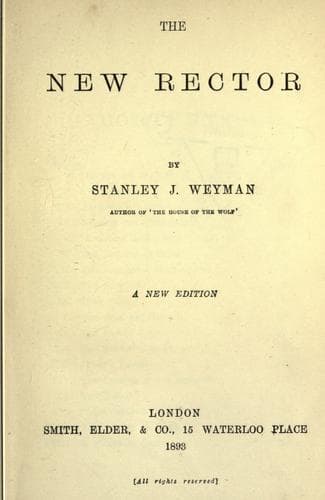
Clergy -- England -- Fiction; England -- Social life and customs -- 19th century -- Fiction
“Thanks!” Jack cried. “All right. Good night.” And that was all; for,
turning abruptly, in a twinkling he had the door open and was gone,
leaving the rector to go to bed in such a state of mystification as
made him almost forget his fallen fortunes.
CHAPTER XIX.
THE DAY AFTER.
Oddly enough, the rector’s first thought on rising next morning was of
his curate. He had expected, as we have seen, that Clode would call
before bedtime. Disappointed in this, he still felt so certain that the
curate would hasten as soon as possible to offer his sympathy and
assistance that after breakfast he repaired to his study for the
express purpose of receiving him. To find one friend in need is good,
but to find two is better. The young clergyman felt, as people in
trouble of a certain kind do feel, that though he had told Jack all
about it, it would be a relief to tell Stephen all about it also; the
more as Jack, whom he had told, was his personal friend, while Clode
was identified with the place and his unabated confidence and esteem—of
retaining which the rector made no doubt—would go some way toward
soothing the latter’s wounded pride.
It was well, however, that Lindo, sitting down at his writing-table to
await his visitor, found there some scattered notes upon which he could
employ his thoughts, and which without any great concentration of mind
he could form into a sermon. For otherwise his time would have been
wasted. Ten o’clock came, and eleven, and half-past eleven; but no
curate.
Mr. Clode, in fact, was engaged elsewhere. About half-past ten he
turned briskly into the drive leading to Mrs. Hammond’s house and
walked up it at a good pace, with the step of a man who has news to
tell, and is going to tell it. The morning was bright and sunny, the
air crisp and fresh, yet not too cold. The gravel crunched pleasantly
under his feet, while the hoar-frost melting on the dark green leaves
of the laurels bordered his path with a million gems as brilliant as
evanescent. Possibly the pleasure he took in these things, possibly
some thought of his own, lent animation to the curate’s face and figure
as he strode along. At any rate, Miss Hammond, meeting him suddenly at
a turn in the approach, saw a change in him, and, reading the signs
aright, blushed.
“Well?” she said, smiling a question as she held out her hand. They had
scarcely been alone together since the afternoon when the rector’s
inopportune call had brought about an understanding between them.
“Well?” he answered, retaining her hand. “What is it, Laura?”
“I thought you were going to tell me,” she said, glancing up with shy
assurance. The morning air was not fresher. She was so bright and
piquant in her furs and with her dazzling complexion, that other eyes
than her lover’s might have been pardoned for likening her to the frost
drops on the laurels. At any rate, she sparkled as they did.
He looked down at her, fond admiration in his eyes. Had he not come up
on purpose to see her?
Public-domain text, read in full here on John Shaqi.
Reviews
Reviews
No reviews yet
Be the first to share your thoughts on this work.
Elsewhere in the archive
Join the Discussion
Join the discussion
Sign in to leave a comment or review.
Sign InorCreate an account