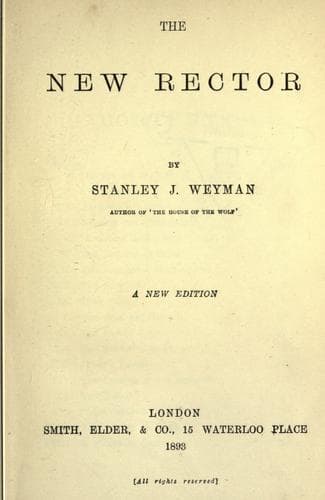
Clergy -- England -- Fiction; England -- Social life and customs -- 19th century -- Fiction
“Can I help it if I do?” he answered sullenly.
“Mother,” said Laura quickly, intercepting the angry reply which was on
Mrs. Hammond’s lips, “if Mr. Clode thinks in that way, can he be blamed
for telling us? We are not the town. What he has told us he has told us
in confidence.”
“A confidence Mrs. Hammond has made me bitterly regret,” he rejoined,
taking skilful advantage of her intervention.
Mrs. Hammond grunted. She was still angry, but she felt herself
baffled. “Well, I do not understand these things, perhaps,” she said.
“But I do not agree with Mr. Clode, and I am not going to pretend to.”
“I am sure he does not wish you to,” said Laura sweetly. “Only you did
not quite understand, I think, that he was only giving us his private
opinion. Of course he would not tell it to the town.”
“Well, that makes a difference, of course,” Mrs. Hammond allowed. “But
now, however, I will say good-morning! I shall go straight to the
rectory now and inquire. Are you coming, Laura?”
Laura thought it better to go and with a bright little nod, tripped off
after her mother. Mr. Clode, thus deserted, walked slowly down the
drive, wondering whether he had been premature in his revolt. He did
not think so; and yet he wished he had not been so hasty—that he had
not shown his hand quite so early. The truth was, he had been a little
carried away by the events of the previous afternoon. But, even now,
the more he thought of it, the more hopeless seemed the rector’s
position. Openly denounced by his patron as an impostor, at war with
his church-warden, disliked by a powerful section of the parish, one
action already commenced against him and another threatened—what else
could he do but resign? “He may say he will not to-day and to-morrow,”
the curate thought, smiling darkly to himself, “but they will be too
much for him the day after.”
And whether Mr. Clode told this opinion of his in the town or not, it
was certainly a very common one. Never had Claversham been treated to
such a dish of gossip as this. On the evening of the bazaar, before the
unsold goods had been cleared from the tables, the wildest rumors were
already afloat in the town. The rector had been arrested; he had
decamped; he was to be tried for fraud; he was not in holy orders at
all; Mrs. Bedford would have to be married over again! With the morning
these reports died away, and something like the truth came to be
known—to the inexpressible satisfaction of Dr. Gregg and his like. The
doctor was in and out of half the houses in the town that day.
“Resign!” he would say with a shriek—“of course he will resign! And
glad to escape so easily!” Dr. Gregg, indeed, was in his glory now. The
parts were reversed. It was for him now to meet the rector with a
patronizing nod; only, for some reason best known to himself, and
perhaps connected with an essential distinction between the two men, he
preferred to celebrate his triumph figuratively, and behind Lindo’s
back.
Public-domain text, read in full here on John Shaqi.
Reviews
Reviews
No reviews yet
Be the first to share your thoughts on this work.
Elsewhere in the archive
Join the Discussion
Join the discussion
Sign in to leave a comment or review.
Sign InorCreate an account