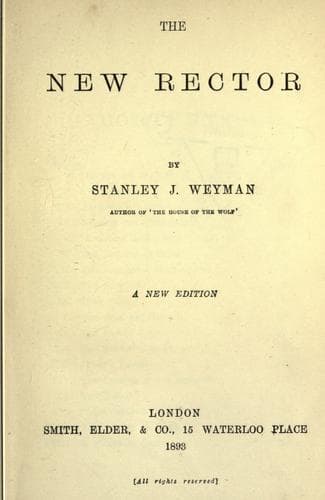
Clergy -- England -- Fiction; England -- Social life and customs -- 19th century -- Fiction
“Yes,” he answered laughing, “I remember that her praise made me almost
jealous of him. That was when I first knew you—when I was coming to
Claversham, you remember, Miss Bonamy, full of pleasant anticipations
and hopes. The reality has been different. Jack has told you, of
course, of Lord Dynmore’s strange attack upon me? But perhaps,” he
added, checking himself, and glancing at her, “I ought not to speak to
you about it, as your father is acting for him.”
“I do not think he is,” she murmured, looking straight before her.
“But—it is true the only communication I have had since has been from
London—still I thought—I mean I was under the impression that Lord
Dynmore had at once gone to your father.”
“I think he saw him at the office,” Kate answered, “but I believe my
father is not acting for him.”
“Do you know why?” said the rector bluntly. “Why he is not, I mean?”
“No,” she said—that and nothing more. She was too proud to defend her
father, though he had let drop enough in the family circle to enable
her to come to a conclusion, and she might with truth have made out a
story which would have set the lawyer in a light differing much from
that in which the rector was accustomed to view him.
Reginald Lindo walked on considering the matter. Suddenly he said, “The
archdeacon thinks I ought to resign. What do you think, Miss Bonamy?”
Her heart began to beat quickly. He was seeking her advice!—asking her
opinion in this matter so utterly important to him, so absolutely
vital! For a moment she could not speak, she was so filled with
surprise. Then she said gently, her eyes on the pavement, “I do not
think I can judge.”
“But you must have heard—more I dare say than I have!” he rejoined with
a forced laugh. “Will you tell me what you think?”
She looked before her, her face troubled. Then she spoke bravely.
“I think you should judge for yourself,” she said in a low tone, full
of serious feeling. “The responsibility is yours. I do not think that
you should depend entirely on any one’s advice, but should try to do
right according to your conscience—not acting hastily, but coolly, and
on reflection.”
They were almost at Mr. Bonamy’s door when she said this, and he
traversed the remainder of the distance without speaking. At the steps
he halted and held out his hand. “Thank you,” he said simply. “I hope I
shall use this advice to better purpose than the last you gave me.
Please remember me to your sister. Good-by.”
Public-domain text, read in full here on John Shaqi.
Reviews
Reviews
No reviews yet
Be the first to share your thoughts on this work.
Elsewhere in the archive
Join the Discussion
Join the discussion
Sign in to leave a comment or review.
Sign InorCreate an account