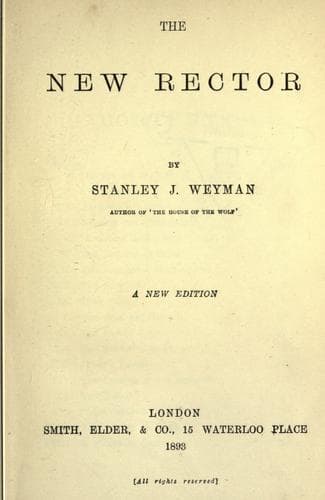
Clergy -- England -- Fiction; England -- Social life and customs -- 19th century -- Fiction
The rector bowed and complied. The request, however, had checked the
current of his speech, even the current of his thoughts, and he did not
finish his sentence. He felt, indeed, for a moment a temptation as
sudden as it was strong. He saw at a glance what his resolve meant. He
discerned that what had appeared to him in the isolation of the night
an act of dignified self-surrender must, and would, seem to others an
acknowledgment of defeat—almost an acknowledgment of dishonor. He
recalled, as in a flash, all the episodes of the struggle between
himself and his companion. And he pictured the latter’s triumph. He
wavered.
But the events of the night had not been lost upon him, and, after a
brief hesitation, he set the seal on his purpose. “You are aware, I
know, Mr. Bonamy,” he said, “of the circumstances under which, in Lord
Dynmore’s absence, I accepted the living here.”
“Perfectly,” said the lawyer drily.
“He has made those circumstances the subject of a grave charge against
me,” the rector continued, a touch of hauteur in his tone. “That you
have heard also, I know. Well, I desire to say once more that I
repudiate that charge in the fullest and widest sense.”
“So I understand,” Mr. Bonamy murmured. He walked along by his
companion’s side, his face set and inscrutable. If he felt any surprise
at the communication now being made to him he had the skill to hide it.
“I repudiate it, you understand!” the clergyman repeated, stepping out
more quickly in his excitement, and glaring angrily into vacancy. “It
is a false and wicked charge! But it does not affect me. I do not care
a jot for it. It does not in any sense force me to do what I am going
to do. If that were all, I should not dream of resigning the living,
but, on the contrary, would hold it, as a few days ago I had determined
to hold it, in the face of all opposition. However,” he continued,
lowering his tone, “I have now examined my position in regard to the
parish rather than the patron, and I have come to a different
conclusion, Mr. Bonamy—namely, to place my resignation in the proper
hands as speedily as possible.”
Mr. Bonamy nodded gently and silently. He did not speak, he did not
even look at the clergyman; and this placid acquiescence irritated the
young man into adding a word he had not intended to say. “I tell you
this as my church-warden, Mr. Bonamy,” he continued stiffly, “and not
as desiring or expecting any word of sympathy or regret from you. On
the contrary,” he added, with some bitterness, “I am aware that my
departure can be only a relief to you. We have been opposed to one
another since my first day here.”
“Very true,” said Mr. Bonamy. “I suppose you have considered——”
“What?”
“The effect which last night’s work may have on the relations between
you and Lord Dynmore?”
“I do not understand you,” the rector answered haughtily, and yet with
some wonder. What did the man mean?
Public-domain text, read in full here on John Shaqi.
Reviews
Reviews
No reviews yet
Be the first to share your thoughts on this work.
Elsewhere in the archive
Join the Discussion
Join the discussion
Sign in to leave a comment or review.
Sign InorCreate an account