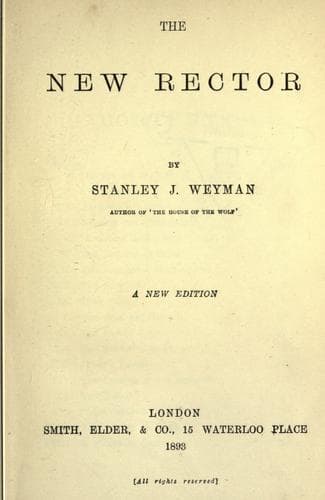
Clergy -- England -- Fiction; England -- Social life and customs -- 19th century -- Fiction
“Thank you,” Lindo answered, choking down his indignation with an
effort. For a week—for a whole week—this, his chosen lieutenant, had
not been near him in his trouble! “I am much obliged to you,” he
continued, “but I am rather surprised that your anxiety on my account
did not lead you to come and see me at the rectory.”
“I called, and failed to find you,” Clode answered, sitting resolutely
down.
Lindo followed his example. “I believe you did once,” he replied
contemptuously. Had a friend been about to succeed him, he could have
borne even to congratulate him. But the thought of this man entering on
the enjoyment of all the good things he was resigning was well-nigh
unendurable. Though he knew that it would best consort with his dignity
to be silent, he could not refrain from pursuing the subject. “You
thought,” he went on, the same gibe in his tone, “that a non-committal
policy was best, I suppose?”
The curate for a moment sat silent, his dark face glowing with
resentment. “If you mean,” he said at last, neither Mrs. Hammond nor
her daughter venturing to interfere—the former because she thought he
was only getting his deserts, and the latter because she felt no call
to champion him at present—“if you mean that I did not wish to publish
my opinion, you are right, Mr. Lindo.”
“I think you published it sufficiently for your purpose’” the young
rector retorted with bitterness.
“Then why throw my non-committal policy in my teeth?” replied the
curate deftly. Thereby winning at least a logical victory.
Lindo sneered and grew, of course, twice as angry as before. “Very
neatly put!” he said. “I do not doubt that you would have got out of
your confession of faith—or lack of faith—as cleverly, if circumstances
had required it.”
The words were scarcely out of his mouth before Miss Hammond rose in a
marked way and left the room; while Clode for a moment glared at him as
though he would resent the insult—for it was little less—in a practical
manner. Fortunately the curate’s, calculating brain told him that
nothing could be gained by this, and with an admirable show of patience
and forbearance he waved the words aside. “I really do not understand
you,” he said with a maddening air of superiority. “I cannot be blamed
for having formed an opinion of my own on a subject which affected me.
Then, having formed it, what was I to do? Publish it, or keep it to
myself? As a fact, I did not publish it.”
“Except by your acts,” said the rector.
“Take it that way, then,” the curate replied, still with patience. “Do
I gather that you would have had me, though I held an opinion adverse
to you, come to you as before, be about you, treat you in all respects
as if I were on your side? Is that your complaint? That I did not play
the hypocrite?”
Public-domain text, read in full here on John Shaqi.
Reviews
Reviews
No reviews yet
Be the first to share your thoughts on this work.
Elsewhere in the archive
Join the Discussion
Join the discussion
Sign in to leave a comment or review.
Sign InorCreate an account