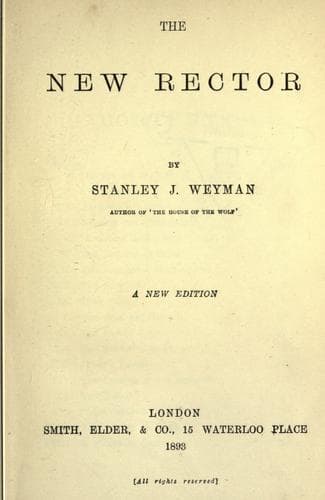
Clergy -- England -- Fiction; England -- Social life and customs -- 19th century -- Fiction
The gas in the big, barely-furnished room, which we have visited more
than once, had just been lit, but the blinds still remained up; and in
this mingling of lights the place looked less home-like and more
uncomfortable than usual. There were three people in the room when the
archdeacon entered. Two sat reading by the fire, their backs to the
door. The third—the future rector—was standing up near one of the
windows, taking advantage of the last rays of daylight to read the
_Times_, which he held open before him. The archdeacon cast a casual
glance at the others, and then stepped across to him and touched him on
the shoulder.
Clode turned with a start. He had not heard the approaching footstep.
One glance at the newcomer’s face, however, set his blood in a glow. It
told him, or almost told him, all; and instinctively he dropped his
eyes, that the other might not read in them his triumph and exultation.
The archdeacon’s first words confirmed him in his hopes. “I have some
good news for you, Mr. Clode,” he said, smiling benevolently. He had of
late distrusted the curate, as we have seen; but he was a man of kindly
nature, and such a man cannot convey good tidings without entering into
the recipient’s feelings. “I saw Lord Dynmore yesterday,” he continued.
“Indeed,” said the curate a little thickly. His face had grown hot, but
the increasing darkness concealed this.
“Yes,” the archdeacon resumed, in a confidential tone which was yet
pretty audible through the room. “You have heard, no doubt, that Mr.
Lindo has resigned the living?”
The curate nodded. At that moment he dared not speak. A dreadful
thought was in his mind. What if the archdeacon’s good news was news
that the earl declined to receive the resignation? Some people might
call that good news! The mere thought struck him dumb.
The archdeacon’s next words resolved his doubts. “Frankly,” the elder
man said in a genial tone, “I am sorry—sorry that circumstances have
forced him to take so extreme a step. But having said that, Mr. Clode,
I have done for the present with regret, and may come to pleasanter
matter. I have to congratulate you. I am happy to say that Lord
Dynmore, whom I saw yesterday, has authorized me to offer the living to
you.”
The newspaper rustled in the curate’s grasp, and for a moment he did
not answer. Then he said huskily, “To me?”
“Yes,” the archdeacon answered expansively—it was certainly a pleasant
task he had in hand, and he could not help beaming over it. “To you,
Mr. Clode. On one condition only,” he continued, “which is usual enough
in all such cases, and I venture to think is particularly natural in
this case. I mean that you have your late rector’s good word.”
“Mr. Lindo’s good word?” the curate stammered.
“Of course,” the unconscious archdeacon answered.
The curate’s jaw dropped; but by an effort he forced a ghastly smile.
“To be sure,” he said. “There will be no difficulty about that, I
think.”
Public-domain text, read in full here on John Shaqi.
Reviews
Reviews
No reviews yet
Be the first to share your thoughts on this work.
Elsewhere in the archive
Join the Discussion
Join the discussion
Sign in to leave a comment or review.
Sign InorCreate an account