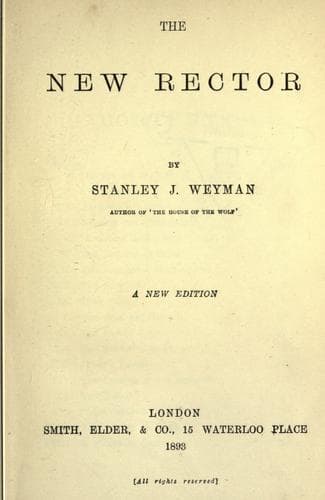
Clergy -- England -- Fiction; England -- Social life and customs -- 19th century -- Fiction
And Laura? Laura, during these changes, showed herself particularly
bright and sparkling. She was not of a nature to feel even defeat very
deeply, or to philosophize much over past mistakes. Her mother saw no
change in her—nay, she marvelled, recalling her daughter’s intimacy
with Mr. Clode and the obstinacy she had exhibited in siding with him,
that Laura could so completely put him out of her mind and thoughts.
But the least sensitive feel sometimes. The most thoughtless have their
moments of care. Even the cat, with its love of home and comfort, will
sometimes wander on a wet night. And there are times when Laura,
doubting the future and weary of the present, wishes she had had the
courage to do as her heart bade her, and make the plunge, careless what
the world, and her rivals, might say of her marriage to a curate. For
Clode’s rugged face and masculine will dominate her still. Though a
year has elapsed, and she has not heard of him, nor probably will hear
of him now, she thinks of him with regret and soreness. She had not
much to give, but to her sorrow she knows now that she gave it to him,
and that in that struggle for supremacy both were losers.
The good wine last. Kate broke the news to Jack herself, and found it
no news. “Yes, I have just seen Lindo,” he answered quietly, taking her
hand, and looking her in the face with dry eyes. “May he make you very
happy, Kate, and—well, I can wish you nothing better than that.” Then
Kate broke down and cried bitterly. When she recovered herself Jack was
gone.
If you were to describe that scene to Jack Smith’s friends in the
Temple they would jeer at you. They would cover you with ridicule and
gibes. There is no one so keen, so sharp, so matter-of-fact, so certain
to succeed as he, they say. They have only one fault to find with him,
that he works too hard; that he bids fair to become one of those legal
machines which may be seen any evening taking in fuel at solitary club
tables, and returning afterward to dusty chambers, with the regularity
of clockwork. But there is one thing even in his present life which his
Temple friends do not know, and which gives me hope of him. Week by
week there comes to him a letter from the country from a long-limbed
girl in short frocks, whose hero he is. Time, which, like Procrustes’
bed, brings frocks and legs to the same length at last, heals wounds
also.
When a day not far distant now shall show him Daintry in the bloom of
budding womanhood, is it to be thought that Jack will resist her? I
think not. But, be that as it may, with no better savor than that of
his loyalty, the silent loyalty of an English friend, could the
chronicle of a Bayard—much less the tale of a country town—come to an
end.
THE END.
Public-domain text, read in full here on John Shaqi.
Reviews
Reviews
No reviews yet
Be the first to share your thoughts on this work.
Elsewhere in the archive
Join the Discussion
Join the discussion
Sign in to leave a comment or review.
Sign InorCreate an account